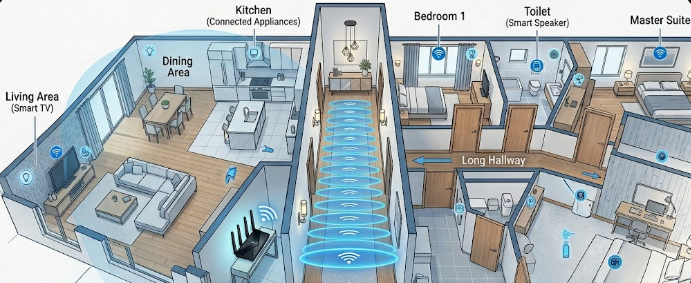
Do you struggle with wireless dead zones in your large or multi-unit home? If you are a DIY home builder or a smart home network installer, you know how frustrating weak signals can be. Fortunately, High-Gain Wi-Fi 7/8 Antennas offer a powerful solution to this exact problem. However, to get the best results, you must understand how antenna specifications work. Many users believe that a bigger antenna simply creates a more powerful signal. In reality, the secret lies in how the antenna shapes and directs the energy throughout your living space.
Decoding the dBi Rating in High-Gain Wi-Fi 7/8 Antennas
When you look at a router specification sheet, you will see a number followed by “dBi.” This term stands for decibels isotropic. Specifically, it measures how effectively an antenna focuses its wireless signal in a particular direction.
It is crucial to understand that a higher dBi rating does not mean the router produces more overall power. Instead, the antenna simply reshapes the existing signal. Think of a standard lightbulb versus a flashlight. A standard bulb sends light in all directions, but it cannot reach very far. On the other hand, a flashlight focuses that exact same amount of light into a tight, powerful beam. Therefore, High-Gain Wi-Fi 7/8 Antennas act just like flashlights for your home network data.
Signal Geometry: Shapes for Different Home Layouts
Antenna gain directly changes the physical shape of your wireless coverage. For instance, a low-gain antenna, such as a 2 dBi model, creates a round, donut-shaped bubble. This bubble spreads the signal evenly in all directions, including up and down. Consequently, this shape works perfectly for multi-story properties where devices sit on different floors.
Conversely, high-gain directional antennas (ranging from 5 dBi to 9 dBi) squash that bubble into a flat, elongated disc. This design works wonderfully for punching signals down long hallways or across wide, open outdoor spaces. However, because the disc is flat, it sends very little signal upward or downward. If you place a high-gain router in a multi-story home, the upper floors might suffer from terrible reception.
Beamforming Synergy with Next-Gen Wi-Fi
Modern wireless technology makes these specialized antennas even smarter. Specifically, Wi-Fi 7 and Wi-Fi 8 utilize an advanced feature called explicit beamforming. This technology allows the router to locate your specific devices and aim concentrated data beams directly at them.
When you combine beamforming with High-Gain Wi-Fi 7/8 Antennas, you achieve outstanding network performance. The high-gain antenna provides a tightly focused signal disc, while beamforming dynamically steers the data beams within that disc to hit high-bandwidth targets. Therefore, your smart TVs and gaming consoles receive a laser-focused connection, which effectively eliminates lag.
Choosing the Right Setup for Your Home
Ultimately, you must match your antenna choice to your building layout. If you manage a sprawling, single-story home or a large outdoor property, then High-Gain Wi-Fi 7/8 Antennas are an excellent choice. They will push the signal horizontally to reach every far corner. For multi-story homes, you should stick with lower-gain options to ensure good vertical coverage. For deeper technical insights into wireless networking standards and next-generation hardware, you can read the latest updates on the official Wi-Fi Alliance website.
References
- IEEE Xplore Digital Library. (2025). Analysis of Antenna Gain and Beamforming in Next-Generation Wireless Networks.
- Wi-Fi Alliance. (2026). Wi-Fi 7 and Wi-Fi 8 Technical Specifications and Deployment Guide.