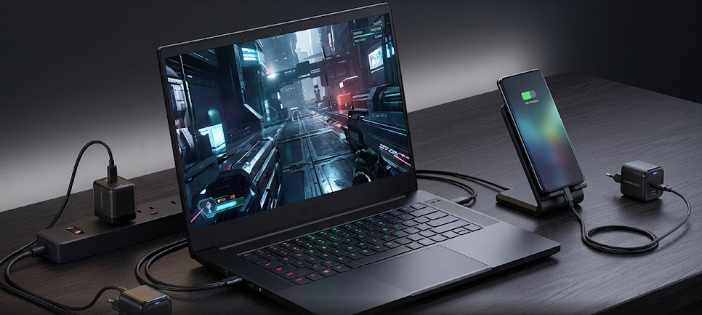
Mobile professionals and laptop power users often struggle with heavy, bulky travel bricks. Fortunately, new technology offers a fantastic solution to this common problem. Manufacturers now produce 5th Gen GaN chargers that easily fit into your pocket while delivering massive power. Furthermore, these modern devices consolidate your charging needs, allowing you to leave the clunky, old power adapters at home. By utilizing Gallium Nitride (GaN) instead of traditional silicon, tech companies create smaller, cooler, and faster charging blocks. Therefore, upgrading your gear makes traveling much lighter and significantly more convenient.
High Switching Frequencies in 5th Gen GaN Chargers
To understand this technology, we must first look at the switching frequency. Older silicon chargers typically operate in the kilohertz (kHz) range. In contrast, 5th Gen GaN chargers switch at incredibly high megahertz (MHz) frequencies. Consequently, this rapid switching speed completely changes how the charger’s internal parts work. Because the chip switches on and off so quickly, manufacturers can use much smaller planar transformers and tiny capacitors. Think of it like carrying water; if you take many fast, small trips (high frequency), you only need a small bucket (small transformer) rather than one massive tank. Thus, high frequencies directly lead to the ultra-compact sizes we see today.
Measuring Power Density in 5th Gen GaN Chargers
When shopping for new tech, you need to know how to evaluate the specifications. Engineers use power density metrics to measure how much power a charger packs into its physical size. Specifically, we measure this in Watts per cubic centimeter (W/cm³). Therefore, a higher number means you get more power from a smaller physical brick. For instance, early silicon chargers had very low power density, meaning a 100W charger took up a lot of space. Today, 5th Gen GaN chargers push these numbers to exciting new limits. By comparing the W/cm³ specification across different brands, you can easily identify which charger offers the best space-saving benefits for your everyday travel bag.
USB-PD 3.1 Compatibility for 5th Gen GaN Chargers
Additionally, the extreme miniaturization of these components makes room for advanced charging protocols. Most notably, 5th Gen GaN chargers fully support the new USB-PD 3.1 standard. This specification allows for an Extended Power Range (EPR) that can deliver up to 240W of power. Previously, heavy-duty gaming laptops required massive, proprietary charging bricks to function properly. Now, you can use a single, pocket-sized brick and a compatible USB-C cable to supply the full 240W your powerful laptop demands. As a result, gamers and mobile professionals can easily power their demanding hardware anywhere in the world without hauling excess weight.
Sustained Power and Thermal Efficiency in 5th Gen GaN Chargers
Finally, we must discuss heat management, because electronics hate excessive heat. During the power conversion process, traditional silicon loses a lot of energy as heat. Conversely, 5th Gen GaN chargers boast exceptional thermal efficiency baselines. They lose significantly less energy, which means the outer casing stays remarkably cool. Because these chargers avoid dangerous overheating, they completely bypass thermal throttling. As a result, your device receives the maximum specified wattage continuously, even over several hours of intense charging. Ultimately, this sustained power delivery ensures your laptop battery fills up as quickly and safely as possible.
In conclusion, upgrading your travel gear to utilize this new technology will dramatically simplify your daily carry. The impressive power density and sustained thermal efficiency give you all the power you need in a tiny package. If you want to learn more about the intricate engineering behind these fast-charging protocols, you should visit the USB Implementers Forum for further reading on the topic.
References
- Navitas Semiconductor. (2023). Next-Generation Gallium Nitride Power ICs: Architecture and Efficiency.
- USB Implementers Forum. (2021). USB Power Delivery Specification Revision 3.1: Extended Power Range (EPR).