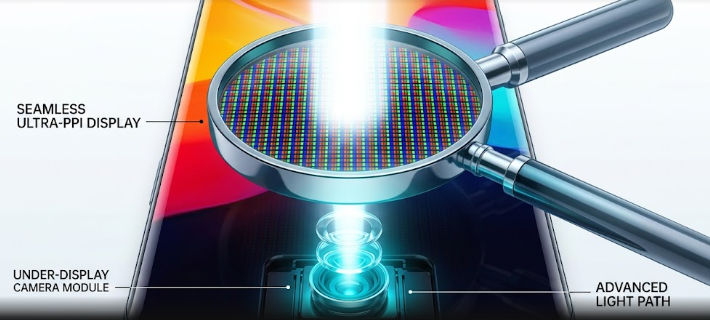
Smartphone screens have finally reached true visual perfection. If you look at modern flagships like the Nubia Z80 Ultra, you will quickly notice a flawless, uninterrupted screen. This magic happens primarily because of under-display cameras in 2026. Today, smartphone makers face a massive engineering conflict. They must hide the selfie camera completely under the screen while still letting enough light reach the hidden sensor. Furthermore, they have to keep the screen looking perfectly sharp. In this article, we will explore exactly how modern engineers balance light transmittance and pixel density to give tech enthusiasts the ultimate viewing experience.
The Pixel Density Threshold for Under-Display Cameras in 2026
Just a few years ago, the screen area covering the hidden camera looked noticeably blurry or pixelated. Engineers had to drastically lower the pixel count in that specific spot so the camera could “see” clearly through the screen. However, under-display cameras in 2026 solve this annoying problem completely. Modern flagship panels now achieve a virtually invisible 430+ Pixels Per Inch (PPI) density directly over the camera hole. Therefore, the camera area perfectly matches the rest of the high-resolution display. You cannot see where the screen ends and the camera begins. For example, imagine looking at a seamless piece of glass; you see no cutouts, no notches, and no distracting punch holes.
Boosting Light Transmittance Specs
Pushing the pixel density up inherently creates a new problem: less light can easily pass through the screen to the camera lens. To fix this, manufacturers use advanced FIAA wiring to make the microscopic screen wires as thin as physically possible. Additionally, they replace traditional thick circular polarizers with a breakthrough technology called Color on Encapsulation (COE). By removing the dark polarizer layer, the screen allows much more light to pass directly through. Consequently, these new structural designs successfully push the light transmittance specification past 40%. This high transmittance ensures the hidden camera sensor receives plenty of light to capture bright, clear selfies.
Overcoming Diffractive Blur in Under-Display Cameras in 2026
Even with incredible light transmittance, physics still gets in the way. The tiny gaps between the millions of display pixels act as a rigid diffraction grating. When light passes through these microscopic gaps, it scatters and bends unpredictably. Consequently, this heavy scattering inherently blurs the image before it ever hits the camera sensor beneath. Think of it exactly like trying to take a clear photo through a tightly woven metal screen door. The screen door scatters the light and makes your photo look incredibly soft and hazy. As a result, engineers building under-display cameras in 2026 must find a clever way to fix this severe physical limitation.
Using Dedicated AI ISPs to Fix Images
To instantly fix the diffractive blur, modern phones rely heavily on serious computational processing power. Phone makers boldly equip these flagship devices with dedicated, high-TOPS Neural Processing Units (NPUs) or specialized Image Signal Processors (ISPs). These incredibly powerful chips use advanced machine learning algorithms to instantly reverse the ugly blur caused by the screen pixels. The camera snaps the scattered image, and the AI processor mathematically reconstructs it into a crisp, sharp photo in mere milliseconds. Ultimately, you get a flawless selfie that looks just as good as one taken with a traditional, exposed camera lens. For further reading on how AI processors continue to revolutionize smartphone photography, you can check out this detailed guide on Android Authority.
References
- Nubia Technology. (2026). Display Innovations and Z80 Ultra Specifications.
- Society for Information Display (SID). (2025). Advancements in Color on Encapsulation (COE) and FIAA Wiring for High-PPI OLED Panels.
- IEEE Computational Intelligence Society. (2025). Reversing Diffractive Blur via High-TOPS Neural Processing Units in Mobile Devices.