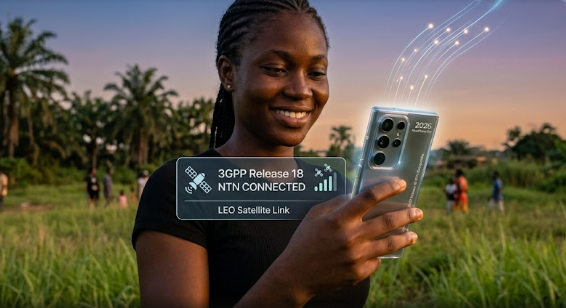
The evolution of mobile technology moves at a blazing speed. A few years ago, direct-to-cell satellite communication felt like science fiction. Today, engineers are making it a standard feature. We are now entering an era where your mobile phone will connect to space just as easily as it connects to a local cell tower. The secret behind this massive upgrade is the new 3GPP Release 18 NTN specification. This framework takes non-terrestrial networks (NTN) out of the experimental phase and plants them firmly into our daily lives.
In this article, we will explore exactly how this technology works. We will break down the engineering upgrades that make satellite connectivity possible for regular handsets. Furthermore, we will explain why you will not need a bulky device to stay connected off the grid.
From Emergency SOS to Daily Connectivity with 3GPP Release 18 NTN
Initially, direct-to-cell satellite features only served as emergency SOS systems. If you got lost in a remote forest, your phone could send a tiny, simple text message for help. However, engineers quickly realized that users wanted more. Therefore, the 3GPP Release 18 NTN standard pushes the boundaries of what commercial smartphones can achieve.
This new specification shifts the focus from simple text alerts to robust, continuous communication. It standardizes the protocol so that mobile network operators can beam regular voice calls and data directly from low-earth orbit (LEO) satellites. As a result, network providers can now offer consistent service in the middle of the ocean or high up in the mountains. You will not need a specialized satellite phone anymore; your standard 2026 smartphone will handle the job seamlessly.
Overcoming RF Limitations: The Magic Behind the Scenes
In the past, satellite phones required massive, protruding antennas to capture weak signals from space. Obviously, consumers do not want antennas ruining the sleek design of modern smartphones. To solve this, the 3GPP Release 18 NTN standard explicitly accounts for the radio frequency (RF) limitations of everyday handsets.
Engineers designed the new specifications around standard phone capabilities. For example, the standard calculates link budgets assuming a low antenna gain of roughly -5.5 dBi. Furthermore, it accounts for polarization loss, which happens when the phone’s internal antenna misaligns with the satellite’s signal. By shifting the heavy lifting to the satellite’s powerful onboard processors, the network compensates for the smartphone’s weak transmission power. Consequently, your phone can maintain a stable connection without turning into a heavy, unpocketable brick.
Understanding L1/L2 Mobility Handover in 3GPP Release 18 NTN
One of the biggest hurdles in satellite communication is the “handover” process. When you drive out of a city, your phone must switch from a terrestrial cell tower to a satellite. Traditionally, this switch required heavy signaling overhead, which caused long delays and dropped calls.
Thankfully, 3GPP Release 18 NTN introduces a much smarter L1/L2 mobility handover framework. Instead of asking the core network to manage the switch entirely, the lower layers (Layer 1 and Layer 2) of the protocol handle the transition locally. For instance, think of it like passing a relay baton between two runners without stopping to ask the coach for permission. This method drastically reduces latency. Therefore, you can stream music in your car, leave terrestrial coverage, and switch to a satellite network without noticing a single hiccup in your audio.
The Role of the n254 Band in Global Roaming
Frequency bands act as the invisible highways that carry our digital data. For satellite communication to work globally, devices need a dedicated, interference-free highway. This is where the n254 band comes into play. The 3GPP Release 18 NTN specification heavily features the n254 band, which operates around the 1.6 GHz and 2.4 GHz spectrums.
Because many countries globally recognize and allocate the n254 band for mobile satellite services, it enables true global roaming. If you buy a 2026 smartphone in the United States, that exact same phone will easily connect to a satellite over the Sahara Desert. The standardization of this band ensures that device manufacturers only need to build one type of internal antenna to serve a global market. Ultimately, this keeps smartphone prices down while expanding coverage worldwide. If you want to learn more about how mobile frequency bands shape our devices, check out Ericsson’s guide to 3GPP satellite communication.
References
- Ericsson. (2024). Using 3GPP technology for satellite communication. Ericsson Technology Review.
- 3GPP. (2024). Release 18 Physical Layer Enhancements for IoT-NTN. 3rd Generation Partnership Project Technical Specifications.
- Guidotti, A., et al. (2026). 5G NR non-terrestrial networks: from early results to the road ahead. npj Wireless Technology.