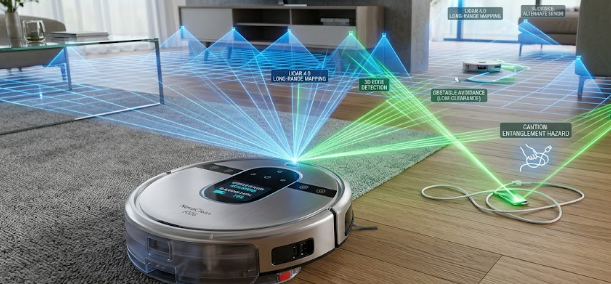
Welcome to the future of automated home cleaning and security. If you want to buy a new robot vacuum, a home security drone, or an automated mower in 2026, you must pay attention to the latest hardware. Specifically, solid-state LiDAR specs dictate how well your devices see and navigate their surroundings. In the past, robots bumped into walls and frequently got stuck on thick rugs. Today, they smoothly glide through complex floor plans. Consequently, understanding these technical details helps you choose the smartest robot for your modern home.
The Solid-State LiDAR Specs Advantage
For years, robot vacuums featured bulky, spinning mechanical laser turrets on their top covers. However, modern designs ditch these moving parts completely. Engineers now build sensors directly into the flat surface of the robot. Therefore, examining solid-state LiDAR specs reveals a massive advantage in physical size. By removing the spinning turret, manufacturers drop the physical height clearance of a robot vacuum from a bulky 100mm down to a sleek 80mm. As a result, your new robot easily cleans under low sofas, beds, and cabinets without getting stuck.
Understanding Direct Time-of-Flight (dToF)
When you compare solid-state LiDAR specs, you will quickly encounter Direct Time-of-Flight, or dToF. This technology sends out a single, intense laser pulse. Next, the sensor measures the exact nanosecond that pulse takes to hit an object and bounce back. Because light travels at a constant speed, the robot calculates the exact distance to the wall or furniture. Furthermore, dToF excels at long-range and outdoor mapping. For example, if you buy an automated lawn mower, dToF allows it to map your entire backyard under bright sunlight with incredible accuracy.
Exploring Indirect Time-of-Flight (iToF)
On the other hand, Indirect Time-of-Flight (iToF) works quite differently. Instead of firing single pulses, an iToF sensor continuously emits modulated light. It then measures the phase shift of the light waves as they return to the robot. Consequently, this method provides incredible, millimeter-level precision at close ranges. For instance, when your robot vacuum needs to dodge a small phone charging cable or a pet toy, iToF gives it the precise vision to navigate safely around the hazard. Therefore, reviewing solid-state LiDAR specs shows that iToF represents the ultimate choice for close-range obstacle avoidance.
Processing Needs for Solid-State LiDAR Specs
Naturally, collecting all this laser data creates a massive amount of information. The robot generates dense point-cloud maps of your entire house every second. However, standard computer chips cannot handle this heavy workload efficiently. Therefore, robot manufacturers now place dedicated Neural Processing Units (NPUs) directly on the robot’s motherboard. These powerful NPUs process the solid-state LiDAR specs in real time. Ultimately, this local, on-board processing allows the robot to make split-second decisions, like swerving away from a suddenly appearing pet, without ever needing an internet connection.
Final Thoughts and Further Reading
Choosing the right robot for your smart home requires a basic understanding of modern sensors. Whether you need the long-range outdoor mapping of dToF or the close-range precision of iToF, looking closely at solid-state LiDAR specs ensures you buy the best machine for your money. As technology advances, these robots will only become smarter, faster, and more efficient. For a deeper dive into how modern robots navigate and build their internal digital maps, please visit the IEEE Spectrum Guide on Robotics and Sensors to explore further reading on sensor engineering.
References
- IEEE Spectrum. (2025). The Evolution of Smart Home Robotics and Navigation.
- Journal of Autonomous Navigation. (2026). Comparing dToF and iToF Sensors in Consumer Electronics.