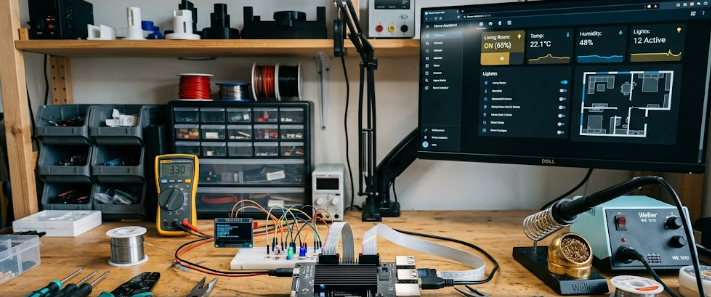
The world of do-it-yourself (DIY) electronics is changing rapidly. For years, hobbyists relied heavily on ARM-based boards like the Raspberry Pi to build home servers and retro emulation consoles. However, consumer RISC-V SBCs now present a powerful alternative. These new single-board computers bring exciting hardware specifications that directly challenge established brands. Consequently, IoT developers and makers are exploring this fresh architecture. In this article, we will explore exactly why these boards are gaining popularity. Furthermore, we will break down the specific hardware features that make them so appealing for your next project.
The Open-Source Edge of Consumer RISC-V SBCs
To understand the hype, we must first define the core technology. RISC-V stands for Reduced Instruction Set Computer. Unlike ARM, which requires companies to pay licensing fees for its proprietary architecture, RISC-V operates as an open-standard specification. Therefore, anyone can design, manufacture, and sell RISC-V chips without paying expensive royalties. This open nature encourages massive innovation among hardware manufacturers. As a result, consumer RISC-V SBCs are becoming more affordable and accessible. You can easily modify and customize the hardware for specific tasks, making it a dream come true for dedicated DIY makers.
Vector Extensions Boosting Consumer RISC-V SBCs
Another standout feature of these modern boards is their processing efficiency. Specifically, developers praise the hardware-level vector processing specs, known as Vector Extensions (RVV 1.0). These extensions allow the processor to handle multiple data points simultaneously. For instance, if you build an AI-powered security camera, the board must process image data quickly. Thanks to RVV 1.0, tiny, low-power consumer RISC-V SBCs can accelerate machine learning and cryptographic workloads efficiently. They achieve this impressive feat without needing a dedicated, power-hungry Graphics Processing Unit (GPU). Thus, you save money and energy while maintaining high performance.
High I/O Bandwidth on Consumer RISC-V SBCs
Building a reliable home server requires excellent networking and data transfer speeds. Fortunately, engineers integrate high-speed lanes directly onto the System-on-a-Chip (SoC) of many modern boards. For example, you will often find native support for PCIe Gen 3 and dual Gigabit Ethernet built right in. This native integration provides superior networking throughput. Consequently, data flows rapidly between your storage drives and the network. Whether you are transferring large media files or streaming retro games, consumer RISC-V SBCs handle the heavy lifting seamlessly. They offer the necessary I/O peripheral bandwidth to keep your projects running smoothly without frustrating bottlenecks.
Thermal Efficiency of Consumer RISC-V SBCs
Power efficiency remains a top priority for IoT developers running always-on devices. Interestingly, these new open-source boards excel in Thermal Design Power (TDP) metrics. Many of these boards operate securely under a 5W power envelope. Because they consume so little electricity, they generate very little heat. Therefore, you do not need noisy fans to keep them cool. You can simply use passive-cooled heat sinks. This extreme efficiency makes consumer RISC-V SBCs perfect for silent, always-on smart home hubs. You can tuck them away in a closet and forget about them while they run your home automation securely.
Final Thoughts on Exploring New Architectures
In conclusion, the hardware specs of these new boards offer incredible value. From open-source freedom and advanced vector processing to robust I/O bandwidth and extreme thermal efficiency, they truly rival ARM. DIY makers now have a fantastic platform for their home servers and IoT devices. As the software ecosystem grows, these boards will only become more capable. If you want to learn more about the technical details of the instruction set and its history, you can read more at the RISC-V International website.
References
- RISC-V International. (n.d.). About RISC-V. RISC-V.
- Patterson, D., & Waterman, A. (2017). The RISC-V Reader: An Open Architecture Atlas. Strawberry Canyon.
- Halfacree, G. (2020). The Official Raspberry Pi Beginner’s Guide (used for ARM comparison context). Raspberry Pi Press.