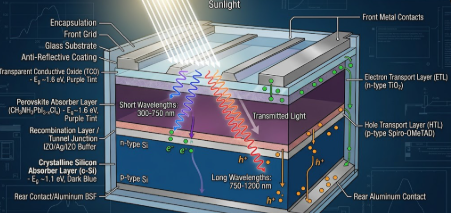
The global energy landscape shifted significantly this week. For decades, engineers relied on standard silicon panels that plateaued at around 22% efficiency. However, the commercial release of Perovskite Tandem Cells has finally shattered the 30% efficiency barrier. This milestone represents more than just a minor upgrade; it is a fundamental shift in how we design and power modern structures. By layering materials, manufacturers have created a “Holy Grail” of renewable energy that maximizes energy harvest from the same surface area.
Understanding the Double Layer Mechanism
To understand why Perovskite Tandem Cells are so effective, we must look at the solar spectrum. Traditional panels use a single layer of silicon, which can only convert a specific range of light into electricity. In contrast, tandem cells use a “double layer” design. The top layer, made of perovskite, is specifically tuned to capture high-energy blue light.
Meanwhile, the bottom silicon layer captures the lower-energy red and infrared light. Because these two materials work in tandem, the panel harvests a much wider range of the solar spectrum than any previous technology. This dual-action approach allows the cell to exceed the theoretical limits that once constrained traditional silicon-only models.
Solving the Stability and Moisture Problem
In the past, civil engineers and developers were skeptical of perovskite due to its sensitivity to moisture. Early prototypes degraded quickly when exposed to the elements. However, the 2026 models of Perovskite Tandem Cells feature advanced encapsulation techniques. These innovations protect the layers from humidity and temperature fluctuations. Consequently, manufacturers now offer 25-year performance warranties. This durability matches standard panels, making them a reliable choice for long-term infrastructure projects and large-scale residential developments.
Faster ROI and Structural Benefits
The high efficiency of Perovskite Tandem Cells directly impacts the bottom line of construction projects. Because these panels produce significantly more power per square meter, you need fewer units to meet energy requirements. This reduction leads to lower costs for mounting hardware and labor during installation. Furthermore, the faster “payback period” makes solar investments more attractive to clients. For a detailed look at the chemical composition of these new layers, you can read more at Solar Power World.
References
- International Renewable Energy Agency (IRENA). (2026). Solar Technology Advancements.
- Journal of Photovoltaics. (2025). Stability Improvements in Perovskite-Silicon Tandem Structures.
Global Solar Council. (2026). Market Trends in High-Efficiency Solar Modules.