Summary of Key Points
- Single-Core Performance: Intel Core i5 processors usually offer higher single-core clock speeds, delivering higher frame rates in competitive esports games.
- Battery & Efficiency: AMD Ryzen 5 processors excel in energy efficiency, offering longer battery life during daily tasks and lightweight gaming.
- Multi-Tasking Power: AMD Ryzen 5 chips handle multi-threaded workloads smoothly for streaming or background productivity.
- GPU Bottlenecking: Both processors easily power entry-level graphics cards without bottlenecking system performance.
Introduction
Shopping for an affordable machine requires smart choices. Gamers on a budget frequently ask: is an Intel i5 or Ryzen 5 better for budget gaming laptops? Both chipmakers produce outstanding mid-range processors, but each brand offers distinct advantages depending on your daily needs.
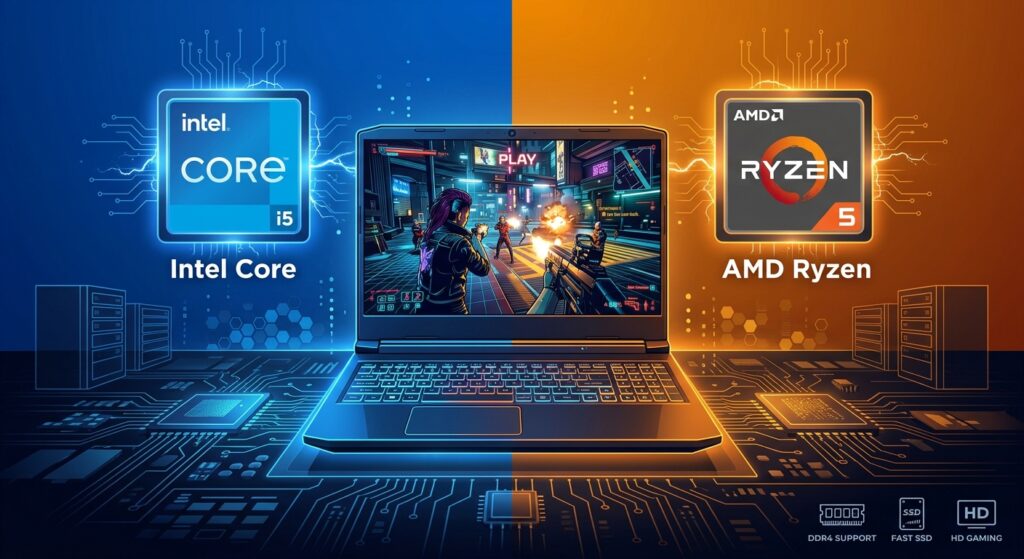
Intel and AMD dominate the portable gaming market today. Choosing between an Intel Core i5 and an AMD Ryzen 5 impacts your game frame rates, laptop heat output, and battery runtime. In this guide, we compare the performance, efficiency, and value of both options to help you choose the ideal processor for your next setup.
Performance Comparison: Intel i5 vs Ryzen 5
When evaluating CPU power, single-core speed directly influences gaming performance. Modern Intel Core i5 chips feature a hybrid architecture combining high-performance cores with high-efficiency cores. This design delivers impressive clock speeds. Consequently, Intel often takes the lead in high-frame-rate titles like Counter-Strike 2, Valorant, or League of Legends.
Conversely, AMD Ryzen 5 processors utilize a unified Zen core architecture. AMD delivers balanced power across all processor cores. Ryzen 5 CPUs process multi-threaded workloads with great efficiency. Therefore, if you edit video, record gameplay, or keep multiple programs open while gaming, a Ryzen 5 chip handles the extra workload without stuttering.
Battery Life and Thermal Efficiency
Power consumption determines how long your laptop lasts away from an outlet. AMD manufactures Ryzen 5 chips on smaller, power-efficient manufacturing nodes. As a result, Ryzen 5 laptops generate less heat and consume less power during basic daily activities. Students and remote workers who want to game in the evening often prefer AMD systems.
Intel Core i5 gaming laptops offer impressive peak performance, but they consume more electricity under heavy load. This extra power consumption increases fan noise and drains the battery faster when unplugged. Thus, AMD consistently wins the battery runtime comparison in budget gaming laptops.
Is an Intel i5 or Ryzen 5 Better for Budget Gaming Laptops with Modern GPUs?
Most budget gaming laptops pair their CPU with dedicated graphics cards like the NVIDIA GeForce RTX 3050, RTX 4050, or AMD Radeon RX 7600S. At this price point, the graphics card almost always limits gaming performance before the processor does.
Because the dedicated GPU handles heavy graphical rendering, both the Intel i5 and Ryzen 5 offer plenty of headroom. Neither chip will bottleneck an entry-level graphics card. Consequently, you should focus on overall laptop pricing, screen quality, and cooling design rather than selecting a laptop based on CPU brand alone.
Final Verdict: Which Processor Should You Buy?
Ultimately, deciding if an Intel i5 or Ryzen 5 is better for budget gaming laptops depends on your main priorities. Choose an Intel Core i5 laptop if you want maximum single-core speed for fast-paced competitive games and do not mind shorter battery life. Select an AMD Ryzen 5 laptop if you prioritize longer battery life, cooler operation, and efficient multi-tasking.
Always compare active sales and individual laptop reviews before buying. For comprehensive hardware benchmarks and industry news, read detailed hardware analysis at Tom’s Hardware.
References
1. Tom’s Hardware – CPU Benchmarks and Hierarchy: https://www.tomshardware.com/reviews/cpu-hierarchy,4312.html
2. Notebookcheck – Mobile Processors Comparison List: https://www.notebookcheck.net/Mobile-Processors-Benchmark-List.2436.0.html