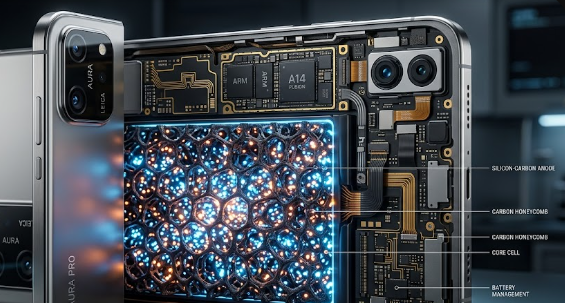
Have you noticed that 2026 flagship smartphones and ultra-thin laptops suddenly feature massive 6,000+ mAh batteries? Manufacturers achieve this without making the devices thicker. Naturally, hardware enthusiasts and smartphone buyers want to know the secret behind this upgrade. The answer lies in a groundbreaking battery technology known as Silicon-Carbon Anodes. Over the past year, battery engineers successfully replaced old graphite materials with this new composite. Consequently, devices now hold way more power in much smaller spaces. Let us break down the exact specifications that make this incredible capacity possible.
Boosting Energy Density with Silicon-Carbon Anodes
For years, battery makers used pure graphite to store energy in lithium-ion batteries. However, graphite has a strict theoretical limit. It can only hold a maximum of 372 mAh/g of energy. In contrast, pure silicon can hold a staggering 4,200 mAh/g. Therefore, engineers started mixing silicon with carbon to create Silicon-Carbon Anodes. This brilliant combination delivers a 20% to 30% leap in real-world volumetric energy density.
For example, imagine you have a small backpack that normally holds three books. If you upgrade to a magic backpack made of this new material, you can suddenly fit five books inside the exact same bag. Similarly, engineers pack much more energy into the same physical battery footprint. Ultimately, this means your laptop or phone runs hours longer without adding any extra weight.
Solving the Physical Expansion Problem
Despite its massive high capacity, pure silicon presents a major engineering challenge. When you charge a battery, lithium ions rush into the anode. As a result, pure silicon expands by up to 300%. This extreme swelling easily fractures the battery internally and destroys it. Fortunately, developers found a clever workaround to stop this mechanical failure.
Instead of using solid chunks of silicon, engineers embed tiny, nano-scale silicon particles inside a highly porous carbon framework. You can picture this framework like a rigid sponge. When the silicon absorbs lithium and expands, the empty microscopic holes in the carbon sponge give it safe room to grow. Therefore, the carbon matrix safely limits the expansion to normal thresholds and protects the battery’s structural integrity.
How Silicon-Carbon Anodes Handle Charge Cycles
Power users always worry about battery health and longevity over time. Thankfully, Silicon-Carbon Anodes easily meet the demands of heavy daily use. To prevent the battery from degrading quickly, designers utilize advanced polymer binders. These special binders essentially act as flexible glue that holds the internal materials together perfectly during rapid charging.
Additionally, engineers optimized the Solid Electrolyte Interphase (SEI). The SEI is a protective stabilization layer that forms inside the battery. By stabilizing this layer, manufacturers guarantee that the battery retains at least 80% of its original capacity even after 800 to 1,000 rapid charge cycles. Consequently, your flagship device will easily last for years before you ever need a battery replacement.
Freeing Up Space Inside Your Phone
Beyond just holding more juice, Silicon-Carbon Anodes dramatically change how hardware teams design the inside of your devices. Because the new battery chemistry is so dense, companies can reduce the physical battery pack volume by roughly 15%. This volume reduction is a huge win for internal hardware layouts.
Furthermore, shrinking the battery frees up critical real estate inside the phone chassis. Hardware designers quickly fill this new space with better cooling systems, such as robust multi-layered vapor chambers. They also use the extra room to install massive, enhanced camera array modules. If you want to dive deeper into the chemistry of next-generation power cells, you can read more about advanced battery technologies at Battery University.
References
- Battery University. (2026). Advancements in Lithium-Ion Chemistry: The Shift to Silicon.
- Journal of Power Sources. (2025). Mitigating Volume Expansion in High-Capacity Silicon Anodes via Porous Carbon Matrices.
- IEEE Spectrum. (2025). How New Anode Materials are Reshaping Smartphone Motherboard Layouts.