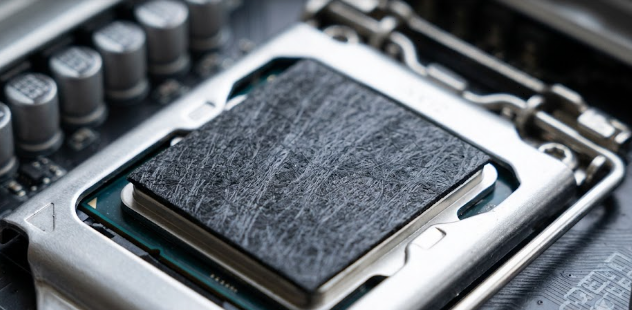
If you build PCs, you know that managing heat is vital. Traditionally, builders rely on liquid thermal paste to bridge the gap between a CPU and its cooler. However, this liquid paste often dries out over time. It also suffers from the pump-out effect, where continuous heating and cooling cycles push the paste out of place. Consequently, you must reapply it regularly to keep temperatures low. Today, carbon nanotube thermal pads offer a permanent, solid-state solution. These solid-state Thermal Interface Materials (TIMs) eliminate paste degradation entirely. For instance, recent material science innovations, such as Noctua’s NT-CP1 launched at Computex 2026, show us the future of cooling. Therefore, hardware modders and extreme overclockers are now switching to carbon nanotube thermal pads for maintenance-free reliability.
How Carbon Nanotube Thermal Pads Excel in Vertical Heat Transfer
To understand why these pads work so well, we must look at their physical specification. Specifically, we measure thermal conductivity in W/mK (Watts per meter-Kelvin). Standard thermal pastes usually hover around 4 to 12 W/mK. In contrast, vertically aligned carbon nanotube arrays deliver incredible bulk thermal transfer capabilities. Because the manufacturers align the nanotubes vertically, they move heat straight up from the processor directly to the cooler. Furthermore, this vertical alignment allows carbon nanotube thermal pads to rival the heat transfer rates of pure liquid metals. As a result, you get top-tier cooling performance without the mess of standard paste.
Micro-Conformability in Carbon Nanotube Thermal Pads
You might wonder how a solid pad fills microscopic air gaps. After all, standard liquid pastes spread easily into every tiny scratch on a CPU integrated heat spreader (IHS). Thankfully, engineers design carbon nanotube thermal pads with a clever polymer-composite matrix. When you apply typical CPU mounting pressure, this matrix physically adapts. Moreover, as your CPU reaches core operating temperatures between 60°C and 80°C, the pad softens slightly. Consequently, it perfectly conforms to all the microscopic imperfections on both the CPU and the cooler base. This micro-conformability ensures excellent contact and heat dissipation.
Electrical Risks of Carbon Nanotube Thermal Pads
While these pads offer amazing thermal benefits, you must consider practical hardware safety. Specifically, you need to know if your specific pad formulation is electrically conductive. Because carbon naturally conducts electricity, some carbon nanotube thermal pads carry electrical conductivity risks. Therefore, you must exercise extreme caution when applying them near sensitive surface-mounted capacitors. This risk increases significantly if you use the pad directly on raw silicon dies, such as in direct-die cooling setups. To stay safe, always check the manufacturer’s specifications. If the pad conducts electricity, you must apply a protective coating or tape to nearby exposed components.
Final Thoughts on Solid-State TIMs
Ultimately, these advanced thermal pads represent a massive leap in PC cooling technology. By eliminating the messy paste, they save you time and keep your temperatures stable for years. Furthermore, they provide a clean, reliable, and highly efficient thermal interface for your most demanding builds. If you want to learn more about advanced PC cooling methods and material science, you can check out this comprehensive guide on Tom’s Hardware for further reading.
References
- Noctua NT-CP1 Computex 2026 Press Release and Product Specifications.
- Thermal Conductivity Metrics for Solid-State TIMs (Hardware Engineering Journals).
- Tom’s Hardware: PC Cooling and Thermal Interface Materials Guide.