As video streaming pushes deeper into 4K, 8K, and high-dynamic-range (HDR) formats, technology companies need better ways to compress massive video files. This creates a fierce competition between video codecs. When we look at VVC (H.266) vs. AV1, we see two powerful approaches to solving the video streaming puzzle. Video content creators, streaming media consumers, and mobile device buyers checking for native System-on-Chip (SoC) decoding support must understand these differences. Consequently, choosing the right standard in 2026 dictates how well your device handles ultra-high-definition video. In this article, we will explore how these codecs operate, how they save your battery life, and why industry politics play a massive role in their adoption.
The 50% Bandwidth Reduction Metric in VVC (H.266) vs. AV1
Engineers designed Versatile Video Coding (VVC), also known as H.266, to drastically slash internet data usage. VVC achieves the same subjective visual quality as older HEVC (H.265) technology but delivers an approximate 50% reduction in data bitrate. For example, if a 4K movie consumes 10 gigabytes of data using HEVC, VVC compresses that exact same quality movie into just 5 gigabytes. Furthermore, when evaluating VVC (H.266) vs. AV1, VVC undercuts AV1 by 15% to 20% for heavy 4K and 8K HDR streams.
Therefore, VVC proves superior for pushing massive pixels over slow internet connections. If you stream live sports in 8K, VVC ensures the video rarely buffers. Meanwhile, AV1 still offers excellent compression, but it cannot quite match VVC’s raw mathematical efficiency on extremely large files.
Coding Tree Unit Architecture Specs of VVC (H.266) vs. AV1
To understand why VVC compresses video so well, we must dive deep into how the compression actually works. Video codecs break moving images into small blocks to process them. AV1 relies on a Superblock architecture. AV1’s maximum Superblock size reaches 128×128 pixels. This works well for large, plain backgrounds like a blue sky. However, VVC takes a more advanced approach.
VVC introduces a highly flexible multi-type tree structure. This multi-type tree allows block sizes to split dynamically into rectangular and square segments, going all the way down to tiny 4×4 pixels. Think of it like tiling a complex bathroom floor. AV1 hands you mostly large, uniform tiles. Conversely, VVC hands you custom-cut tiles of various shapes to perfectly capture fine details around sharp edges. Ultimately, this dynamic splitting helps VVC capture fine motion vectors efficiently, creating crisper images during fast-paced action scenes.
Hardware Decoder IP Blocks: VVC (H.266) vs. AV1 on 2026 Silicon
You need specialized microchips to play back these advanced video formats smoothly. We call these dedicated hard-silicon blocks Hardware Decoder IP Blocks. Tracking silicon integration reveals exactly which devices support which format. In 2026, several new processors feature dedicated VVC decoding blocks. For instance, Intel Lunar Lake (Core Ultra series) processors, MediaTek Pentonic 800 and 700 TV chipsets, and the Qualcomm Snapdragon 8 Elite mobile SoC all include hardware-level VVC support.
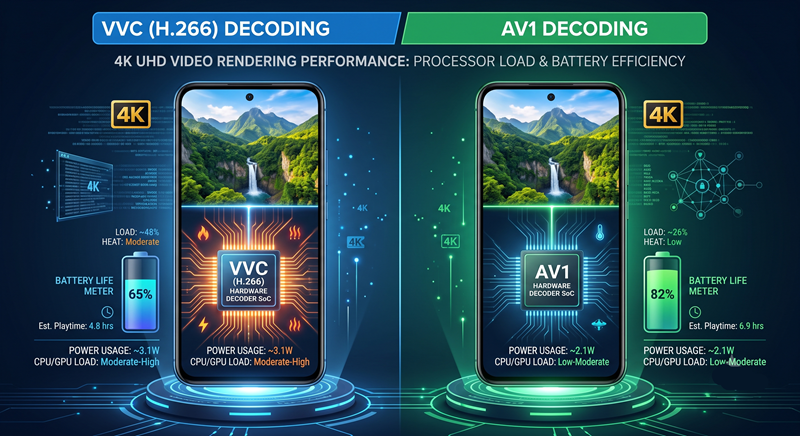
This hardware integration matters deeply for battery life. When a device features hardware decoding, it experiences near-zero battery drain because the specialized chip handles the math effortlessly. On the other hand, software-based rendering forces the main CPU to do all the heavy lifting. This causes a massive battery penalty. Your phone will overheat and drain its battery in minutes if it tries to decode VVC or AV1 video using software alone.
Licensing Framework Complexities: VVC (H.266) vs. AV1
Technology relies heavily on industry politics. The licensing framework dictates which devices natively support which standard. The Alliance for Open Media developed AV1 as a royalty-free, open-source specification. Anyone can integrate AV1 into their software or hardware without paying a single dime. Consequently, internet browsers like Google Chrome and platforms like YouTube overwhelmingly champion AV1.
Conversely, VVC operates under commercial licensing pools, primarily Access Advance and MPEG LA. Manufacturers must pay licensing fees to include VVC hardware support in their televisions, phones, and streaming boxes. This commercial cost splits the industry. Premium television manufacturers and broadcast networks readily pay for VVC to secure its superior 8K compression. Meanwhile, open web developers stick to AV1.
To make an informed purchase in 2026, you must check your device specifications carefully. If you want to dive deeper into how modern video codecs alter global network infrastructure and daily streaming efficiency, you can read more at Streaming Media.
References
- Ant Media. “Versatile Video Coding (VVC): H.266 Codec Guide for Streaming.” Ant Media Documentation, 2026.
- Dacast. “H.266 Codec: What is Versatile Video Coding (VVC)?” Dacast Blog, 2025.
- Alliance for Open Media. “AV1 Specification and Compression Efficiency.” AOMedia, 2024.
- MainConcept. “MainConcept VVC/H.266 Decoder: Overview of Key Features.” MainConcept Blog, 2025.