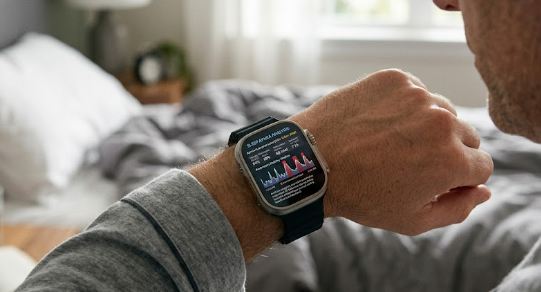
Have you ever wondered how your smartwatch knows if you sleep well? Today, consumer sleep apnea detection changes how we monitor our health. Manufacturers now build powerful medical-grade tools right into our daily wearables. Consequently, you no longer need to rely solely on bulky hospital equipment to catch early warning signs. In this article, we will explore the technology behind these life-saving devices. Furthermore, we will break down the complex FDA-cleared wearable sensor specs into simple terms so you know exactly what your smartwatch is doing.
Moving Beyond Basic Tracking for Consumer Sleep Apnea Detection
A few years ago, smartwatches only tracked basic sleep stages. They used simple accelerometers to guess if you were awake or asleep based on your tosses and turns. However, modern devices, like the Apple Watch Series 10 or specialized fitness rings, do much more. They utilize advanced diagnostic metrics to monitor your health deeply.
Therefore, the shift from simple motion tracking to true consumer sleep apnea detection represents a massive leap in wearable technology. Engineers now pack sophisticated sensors into tiny spaces. As a result, these modern wearables analyze your body’s vital signs precisely. They look for specific patterns rather than just measuring your movements. This upgrade gives users actionable health data, ultimately bridging the gap between consumer gadgets and clinical tools.
The Breathing Disturbance Index in Consumer Sleep Apnea Detection
To understand these devices, you must learn about the Breathing Disturbance Index (BDI). This metric plays a crucial role in modern consumer sleep apnea detection. Specifically, the hardware tracks microscopic wrist or finger movements. Simultaneously, the sensors watch for sudden, brief drops in your blood oxygen levels (SpO2).
When the device detects both events at once, it records a breathing disruption. Over time, the wearable calculates these disruptions to form your baseline BDI. For example, if you stop breathing for a few seconds, your blood oxygen drops. The watch immediately catches this subtle change. Consequently, this detailed tracking helps the software recognize patterns over several nights. By combining motion and oxygen data, these gadgets provide highly accurate health insights.
PPG Sampling Frequencies and Battery Management
You might wonder how these small devices capture such precise data. They use Photoplethysmography (PPG) sensors to shine light into your skin and measure blood flow. To achieve FDA clearance for consumer sleep apnea detection, the sensor must change its behavior during the night. Specifically, it must increase its sampling rate during deep sleep phases.
This fast sampling demands a lot of power. Therefore, engineers face a tough challenge. They must run the sensors frequently without completely draining the device’s small milliamp-hour (mAh) battery. Fortunately, smart algorithms solve this problem. The watch only triggers high-frequency sampling when you enter specific sleep stages. Thus, it saves battery life while still capturing the critical medical-grade data needed for accurate analysis.
Data Aggregation Tolerances for Consumer Sleep Apnea Detection
It is important to know that these wearables do not diagnose you instantly after one night. Instead, they rely on strict data aggregation tolerances to ensure accuracy. The algorithms demand a 10-to-14-day data profile to confidently evaluate your sleep. This waiting period is essential for reliable consumer sleep apnea detection.
Why do they need so much time? They must safely filter out false positives. Sometimes, a simple night of snoring, a stuffy nose, or standard restlessness can look like a breathing issue. By analyzing your data over two weeks, the system establishes your normal baseline. Finally, if the device consistently detects irregular breathing patterns over this period, it alerts you.
Conclusion
In summary, modern wearables offer incredible tools for monitoring our health. The shift toward medical-grade sensors makes early intervention easier than ever before. From tracking your Breathing Disturbance Index to managing PPG sensor battery life, the engineering behind these gadgets is truly remarkable. If you want to dive deeper into how medical devices receive approval and track such data, check out this comprehensive guide on FDA digital health regulations. By understanding these features, you can make better choices when buying your next health-focused smartwatch.
References
- U.S. Food and Drug Administration (FDA). “Digital Health Center of Excellence.” FDA.gov.
- Apple Inc. “Sleep Apnea Notifications on Apple Watch.” Apple Health Feature Summaries, 2024.
- National Sleep Foundation. “Understanding Sleep Apnea and Wearable Technology.” SleepFoundation.org, 2023.