Have you ever wondered how your smartphone takes sharp photos even when your hands shake? The secret lies in Optical Image Stabilization (OIS). Recently, a big tech battle has emerged regarding Shape Memory Alloy vs Voice Coil Motor OIS systems in flagship phones. Manufacturers want to give you the best camera experience, but they use different mechanical methods to achieve it. Understanding this technology helps you make better buying decisions when comparing top-tier phone cameras.
The Mechanical Shift in Smartphone Cameras
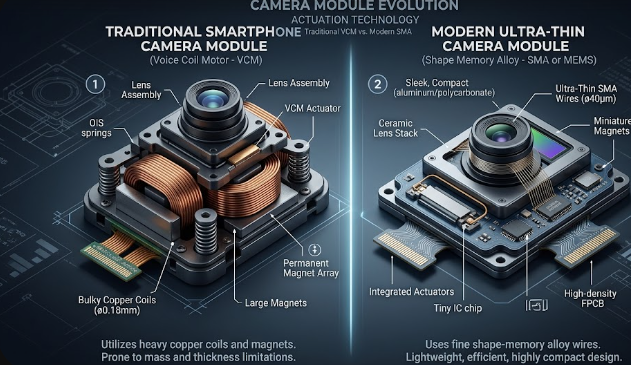
For years, phone companies relied heavily on Voice Coil Motors (VCM) to stabilize lenses. A standard VCM setup uses heavy permanent magnets and copper wire coils. When electrical current passes through these coils, it creates a magnetic field that physically shifts the entire lens assembly to counteract your hand movements. While this method works well, it requires significant physical space and adds noticeable weight to the camera module.
In contrast, Shape Memory Alloy (SMA) actuators offer a completely different mechanical approach. Instead of bulky magnets, SMA technology uses specialized, hair-thin metal wires. These unique wires physically contract and expand when engineers apply a precise electrical current to them. This thermal reaction moves the lens rapidly and accurately, completely changing how engineers design modern mobile camera systems.
Weight and Size Benefits of Shape Memory Alloy vs Voice Coil Motor OIS
As smartphone sensors grow larger, space inside the phone body becomes extremely valuable. Because SMA completely eliminates bulky magnets and copper coils, it drastically reduces the physical footprint of the camera module. Therefore, manufacturers can pack massive image sensors into thin phones without creating huge, heavy camera bumps.
Furthermore, removing magnets solves a major engineering headache. Traditional VCM magnets can cause severe magnetic interference with neighboring lenses in a multi-camera array. For example, the magnet from a telephoto lens might disrupt the main camera. Because SMA actuators do not use magnets, they eliminate this risk entirely. Consequently, phone brands can place multiple high-powered cameras close together without performance issues.
Performance Battle: Multi-Axis Stabilization Limits
When we look at speed and accuracy, the difference between these two technologies becomes even clearer. A standard 4-wire SMA configuration allows for superior X and Y-axis stabilization. In addition, it enables active lens tilt, which corrects for rotational movements when you walk or run.
As a result, SMA systems react to micro-tremors from your hand with mathematically faster response times than spring-based VCM setups. Traditional VCM systems rely on tiny mechanical springs to hold the lens, which can wobble or lag during sudden movements. SMA wires pull tightly and release instantly, giving you incredibly smooth video and sharper low-light photos.
Final Thoughts on Shape Memory Alloy vs Voice Coil Motor OIS
Choosing a flagship phone often comes down to camera performance. While VCM remains a reliable and affordable choice for mid-range devices, SMA represents the future for premium photography. It gives you bigger sensors, lighter phone designs, and faster stabilization. To learn more about advanced mobile hardware and camera mechanics, check out Android Authority for deep dives into upcoming smartphone sensor tech.
References
- Cambridge Mechatronics. (2024). Shape Memory Alloy (SMA) Technology for Smartphone Cameras.
- IEEE Transactions on Magnetics. (2023). Comparison of Voice Coil Actuators and Smart Materials in Miniature Optical Systems.
- Image Sensors World. (2025). Trends in Mobile Camera Modules: OIS and Actuator Evolutions.