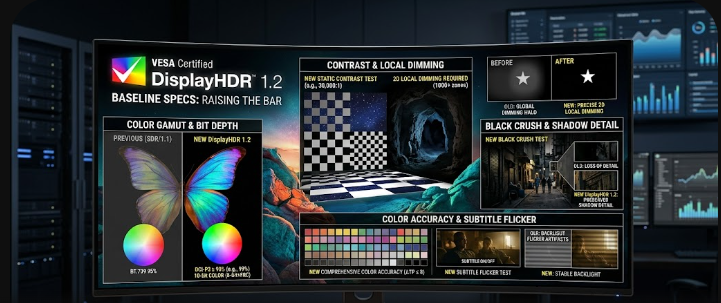
If you plan to buy a new PC monitor, you must understand the latest VESA DisplayHDR 1.2 baseline specs. For a long time, video editors and PC gamers felt frustrated by confusing compliance logos. Manufacturers often slapped “HDR” stickers on cheap displays that delivered terrible visual experiences. Consequently, the Video Electronics Standards Association (VESA) stepped in to fix this problem. They introduced a massive update that dramatically improves what entry-level HDR means. Therefore, if you want true high dynamic range, you need to know exactly what these new rules change. This article will break down the new strict requirements in simple English. We will explore how these changes finally bring premium features to budget-friendly screens.
The DCI-P3 Baseline in VESA DisplayHDR 1.2 Baseline Specs
First, let us look at the major upgrade to the entry-level tier. In the past, monitors only needed basic sRGB color coverage to earn a DisplayHDR 400 logo. This meant that cheap monitors looked completely washed out. Fortunately, the VESA DisplayHDR 1.2 baseline specs now strictly mandate a 90% DCI-P3 color gamut. DCI-P3 is a wider color space that shows far more vivid reds, greens, and blues.
Furthermore, the new rules require an 8-bit + 2-bit (FRC) color depth, even for the lowest DisplayHDR 400 tier. What does this mean for you? For example, instead of seeing ugly, blocky color transitions in a sunset video, you will see a smooth blend of colors. Ultimately, this change brings low-end monitors much closer to premium professional specs.
Dynamic Black Level Testing Methodology
Next, the updated standard introduces a massive shift in dynamic black level testing. Previously, testers measured black levels on a pure, 100% black screen. Unsurprisingly, manufacturers used edge-lit monitors to cheat this test. They simply shut off the entire backlight to achieve a “perfect” black reading. However, this trick ruins the actual viewing experience when you watch real movies.
To stop this, VESA changed the methodology. Now, testers must evaluate black levels with an active 8% white patch shining on the screen. Because the screen displays bright white in the center, the monitor cannot turn off its backlight completely. Therefore, this test proves the true contrast performance of the display. If a monitor cannot keep the dark areas dark while showing bright spots, it will fail.
Color Accuracy Under VESA DisplayHDR 1.2 Baseline Specs
Another huge improvement involves rigorous color testing. Displaying colors accurately at different brightness levels is extremely difficult. In the past, monitors shifted colors wildly when scenes got brighter. The new VESA DisplayHDR 1.2 baseline specs demand a strict average Delta-TP error of less than 8.
Testers now check 96 different color patches at three distinct luminance levels. Delta-TP measures how far a displayed color deviates from its true intended color. For instance, if you edit a video of a person walking from a dark room into bright sunlight, their skin tone should remain identical. Because the spec requires such a low Delta-TP score, video editors can finally trust the colors on an entry-level HDR monitor.
The Subtitle Flicker Test for Real-World Usage
Additionally, VESA added a brilliant real-world scenario test: the subtitle flicker test. Have you ever watched a dark, moody movie scene with subtitles turned on? On older HDR monitors, sudden bright elements like white subtitles caused the local dimming zones to violently pulse. This annoying “flicker” ruined the viewing experience for many movie lovers and gamers.
To solve this, the new specification ensures that sudden, bright text does not overwhelm the dimming zones. The monitor must smoothly manage its backlight without pulsing or washing out the dark background. Consequently, you can watch your favorite subtitled anime or dark thriller movies without distracting light flares.
Conclusion and Further Reading
In summary, the updated standard completely changes the PC monitor market. The new VESA DisplayHDR 1.2 baseline specs guarantee that even budget monitors deliver great color, true contrast, and flicker-free viewing. Manufacturers can no longer use cheap tricks to earn an HDR badge. Finally, gamers and creators will get exactly what they pay for. For more detailed technical information on these display standards, you can visit the official DisplayHDR website to read their performance criteria.
References
- Video Electronics Standards Association (VESA). (2024). DisplayHDR Performance Criteria 1.2.
- Hachman, M. (2024). VESA’s new HDR spec makes low-end monitors less miserable. PCWorld.
- VESA. (2024). VESA Elevates PC and Laptop HDR Display Performance with Updated DisplayHDR Specification. PR Newswire.