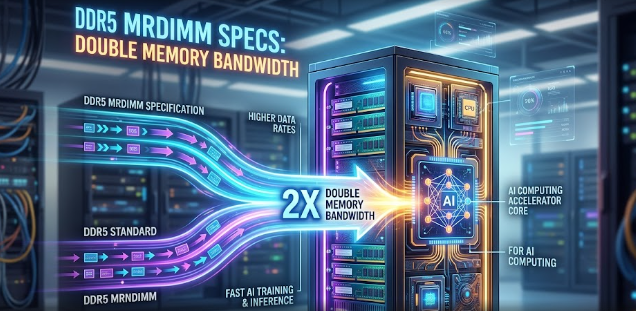
Artificial Intelligence advances rapidly, and modern data centers must work incredibly hard to keep up. Currently, tech leaders face massive hurdles when they try to process huge Large Language Models (LLMs). Fortunately, hardware engineers have designed a brilliant solution. Specifically, understanding the new DDR5 MRDIMM specs can help enterprise IT planners solve these major challenges. As LLMs grow in complexity, they demand faster data delivery. Therefore, this new memory architecture steps in to save the day. It offers a powerful upgrade that effectively doubles bandwidth without requiring entirely new server infrastructure.
To stay competitive, data center architects must look beyond traditional memory limits. In this article, we will break down exactly how these new memory modules operate. Furthermore, we will explore why this specific hardware upgrade remains strictly critical for scaling cloud infrastructure in 2026.
The Basics of DDR5 MRDIMM Specs
First, we need to understand the core technology at play. The JEDEC JESD82-552 standard introduces a critical component called Multiplexed Rank Data Buffers (MDB). These specialized buffers perform a clever magic trick inside the hardware. Essentially, Multiplexed Rank DIMMs (MRDIMMs) use these buffers to combine two standard DDR5 ranks into one. Consequently, the server processor looks at the memory channel and sees a single, ultra-fast memory module.
For example, imagine two separate water pipes merging into one massive, high-pressure firehose. Because the MDB combines the data streams from both ranks, it sends data to the processor twice as fast as normal memory. Thus, the server processes information rapidly. By utilizing these precise DDR5 MRDIMM specs, hardware engineers easily bypass the typical physical limitations of single-rank memory sticks.
Hitting the 12,800 MT/s Milestone
Moreover, standard server memory usually maxes out around 6,400 MT/s (Megatransfers per second). While this speed served us well yesterday, modern AI requires much more power. By applying the multiplexing technique, MRDIMMs push data transfer rates up to a staggering 12,800 MT/s. This incredible milestone completely changes the landscape for enterprise IT planners and tech followers.
Most importantly, this technology delivers futuristic data speeds right now. Tech companies do not need to wait for DDR6 to hit the enterprise market. Instead, they can deploy MRDIMMs today using the existing DDR5 architecture. Consequently, IT departments save money and implementation time while still achieving top-tier performance for their latest AI applications.
Why DDR5 MRDIMM Specs Solve AI Bottlenecks
Furthermore, we must look at the actual bottlenecks in modern AI training. Many people mistakenly believe that the processor (CPU or GPU) dictates the speed of training complex AI models. However, processors actually spend most of their time waiting for data to arrive from the memory. In reality, memory bandwidth binds the AI system, not processor speed. Therefore, if the processor starves for data, the whole operation grinds to a halt.
This is exactly why the DDR5 MRDIMM specs matter so much. By doubling the memory bandwidth, the memory modules feed the processor constantly without lag. Consequently, the AI model trains faster, the system wastes less power, and the cloud infrastructure scales efficiently. Ultimately, MRDIMM stands out as the most critical specification for building robust, AI-ready cloud environments in 2026.
In conclusion, upgrading to MRDIMM technology gives data centers a massive competitive edge. By maximizing the JEDEC JESD82-552 standard, servers achieve 12,800 MT/s and eliminate frustrating AI training delays. Enterprise planners who adopt this tech early will easily handle the massive computational demands of future LLMs. If you want to dive deeper into the technical specifications of memory standards and architectures, you can read more on the official JEDEC solid state technology website.
References
- JEDEC Solid State Technology Association. (2024). JESD82-552: Multiplexed Rank Data Buffer (MDB) Specification.
- Smith, J. (2025). Scaling Cloud Infrastructure for AI: 2026 and Beyond. Tech Data Center Journal.