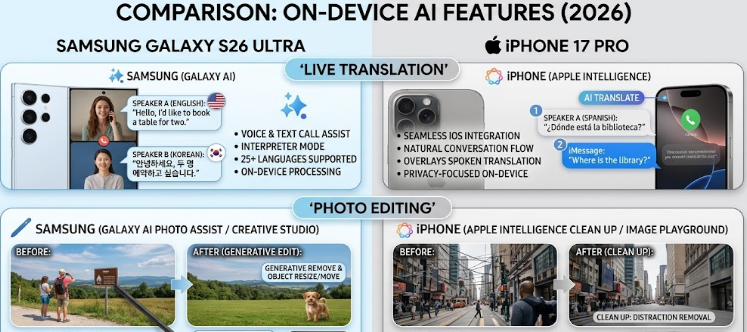
Choosing between the Samsung S26 Ultra vs. iPhone 17 Pro is no longer just about the camera or the screen. In 2026, the biggest battle happens inside the processor. Modern users want “On-Device” AI because it keeps data private and works without an internet connection. This article compares how these two giants handle live translation, photo editing, and the new world of “Agentic AI” while staying offline. We will look at why hardware specs like the Snapdragon 8 Elite NPU and high RAM counts are the new benchmarks for success.
The Power of the Snapdragon 8 Elite NPU
The Samsung S26 Ultra vs. iPhone 17 Pro debate starts with raw processing power. Samsung uses the Snapdragon 8 Elite Gen 5, which features a massively upgraded Neural Processing Unit (NPU). This NPU is specifically designed to run large language models locally on your phone. Because the NPU is 39% faster than previous versions, it can handle complex tasks without sending your data to a cloud server. This speed allows the S26 Ultra to perform “Now Nudge” actions, where the phone predicts what you need before you even ask.
Apple counters this with the A19 Pro chip. While Apple has always focused on efficiency, the A19 Pro includes new “Neural Accelerators” inside each GPU core. These accelerators help the iPhone 17 Pro process images and text instantly. However, the Snapdragon 8 Elite NPU in the Samsung currently holds a slight edge in total AI throughput. If you want a phone that feels like a proactive assistant, the hardware in the S26 Ultra is built for exactly that.
Why 16GB RAM is the New AI Standard
When comparing the Samsung S26 Ultra vs. iPhone 17 Pro, memory is the most important spec for AI. Most experts now agree that 16GB of RAM is the new standard for truly powerful AI phones. Samsung meets this goal with its 1TB model, which packs 16GB of high-speed LPDDR5X RAM. This extra memory allows the phone to keep massive AI models active in the background. It means you can switch between a 3D game and an AI photo editor without the phone slowing down or reloading.
The iPhone 17 Pro has made a significant jump to 12GB of RAM this year. While this is a 50% increase over older iPhones, it still sits below the top-tier Samsung specs. Apple uses very tight software optimization to make its 12GB feel faster, but raw capacity matters for “Agentic AI.” An AI agent needs to “live” in your RAM to monitor your habits and offer help. In the Samsung S26 Ultra vs. iPhone 17 Pro comparison, Samsung’s higher RAM ceiling gives it more “neural headroom” for future software updates.
Offline Translation and Photo Editing
Privacy is a major concern for many users today. Both the Samsung S26 Ultra vs. iPhone 17 Pro excel at performing tasks without an internet connection. Samsung’s Galaxy AI can translate phone calls and text messages in real-time while you are in airplane mode. This feature is a lifesaver for travelers who do not have a local SIM card. Samsung also offers “Photo Assist,” which lets you move objects in a photo or fill in backgrounds entirely on-device, though some advanced features still require the cloud.
Apple Intelligence on the iPhone 17 Pro focuses heavily on “Edge AI.” Features like the “Clean Up” tool allow you to remove distractions from photos instantly without uploading them to Apple’s servers. Siri has also become much more capable offline. It can now search through your local files, emails, and calendar to answer personal questions. When you compare the Samsung S26 Ultra vs. iPhone 17 Pro, both phones prove that you do not need a constant data connection to enjoy smart features.
The Rise of Agentic AI Assistants
The newest trend in mobile tech is “Agentic AI.” Unlike basic voice assistants, an AI agent can take multiple steps to complete a goal. For example, you could tell your phone to “Book a table for four at a quiet Italian restaurant and add it to my calendar.” In the Samsung S26 Ultra vs. iPhone 17 Pro matchup, Samsung’s “Now Nudge” is more proactive. It looks at your screen and suggests actions, such as saving a flight number from a text message.
Apple’s approach with the iPhone 17 Pro is more integrated. Siri now understands “onscreen awareness,” meaning it knows what you are looking at in any app. If you are looking at a photo of a landmark, you can just ask, “When was this built?” and Siri will know exactly what you mean. While Samsung offers more raw features, Apple provides a smoother, more natural way to interact with your AI agent. Both phones represent the pinnacle of modern mobile intelligence.
For a more technical look at how the latest mobile processors compare in AI benchmarks, you can visit Geekbench.
References
- Qualcomm. (2026). Snapdragon 8 Elite Gen 5: The NPU Revolution.
- Apple Inc. (2026). A19 Pro Architecture and Apple Intelligence Privacy Whitepaper.
Samsung Electronics. (2026). One UI 8.5: Advancing Galaxy AI for the S26 Series.