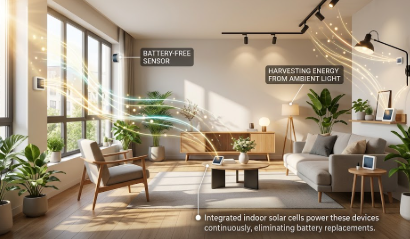
May 2026 has brought a massive shift in how we power our home gadgets. We are finally saying goodbye to the constant hassle of replacing small coin-cell batteries. Battery-Free Smart Home Sensors are now the standard for modern houses. These clever devices do not need a charging cable or a battery swap to function. Instead, they “eat” the energy already floating around your rooms to stay powered forever.
Tech pioneers like Gemns have led this movement. Today, most smart home specifications include devices that harvest their own power. This technology ensures that your home stays smart without adding more tasks to your to-do list. Consequently, the days of finding a dead motion sensor or a non-responsive door alarm are over.
How Battery-Free Smart Home Sensors Harvest Energy
These sensors use a process called “energy harvesting” to stay alive. Essentially, they gather tiny amounts of power from their immediate environment. For instance, some sensors have microscopic solar cells that work perfectly with dim indoor light. Others are even more advanced. They can pull energy from the Wi-Fi signals and radio waves that already fill your home.
Furthermore, some models use temperature fluctuations to create electricity. When the air in your room warms up or cools down, the sensor converts that thermal change into a small power boost. Therefore, the device always has enough energy to send signals to your smart hub. Because they use low-energy protocols like Matter, they only need a tiny “sip” of power to work.
The Power of the Satisfying Click
Another exciting trend in 2026 is the use of kinetic hardware. You might notice new light switches that feel a bit different when you press them. These switches do not have a battery or a wired power source inside. Instead, the physical act of pushing the button creates a tiny pulse of electricity. This is often called the “satisfying click” because you can feel the energy being made.
This small burst provides just enough power to tell your smart hub to turn on the lights. Because of this clever design, you never have to worry about a “dead” switch during a power outage or a battery failure. It works every single time because you provide the power with your finger. This technology makes modern smart homes feel more reliable and mechanical.
Reliability and Maintenance-Free Specs
When you look at the technical specs for a new home today, longevity is a top priority. Battery-Free Smart Home Sensors offer a theoretical lifespan of over 15 years. This duration is impressive because it effectively matches the actual wiring inside your walls. In the past, owning fifty smart sensors meant changing fifty batteries every single year.
Now, you can install a sensor and forget about its existence for a decade or more. This maintenance-free lifestyle is why these sensors are the preferred choice for professional builders and savvy homeowners. They offer peace of mind and save you a significant amount of money on replacement parts over time. Additionally, they reduce the risk of your home security system failing when you are away on vacation.
Saving the Planet with Battery-Free Smart Home Sensors
Sustainability is no longer just a buzzword; it is a legal requirement in many regions. In 2026, the EU and the US have introduced strict “E-Waste Reduction” mandates. These laws push manufacturers to move away from disposable batteries that leak chemicals into the ground. As a result, many new buildings must use hardware that reduces environmental impact.
Battery-Free Smart Home Sensors are the primary tool for meeting these new green standards. They help builders achieve LEED certification by eliminating thousands of toxic batteries over the life of a building. By choosing these devices, you are helping the environment while enjoying the latest technology. It is a win-win situation for both the homeowner and the planet.
To learn more about the latest building standards and green hardware, check out the official USGBC LEED certification guide.
References
- Gemns Energy Harvesting Whitepaper (April 2026).
- Global Smart Home Trends Report (May 2026 Tech Summit).
- European Union E-Waste Directive Update (January 2026).
- LEED v5 Sustainability Standards for Smart Buildings.