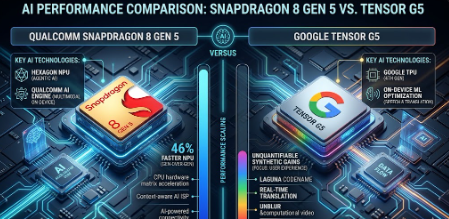
The year 2026 has brought a massive shift in how we look at smartphone power. For years, we only cared about how fast a phone could open an app or play a game. Today, the conversation is different. The recent benchmark leaks for the Snapdragon 8 Gen 5 vs. Tensor G5 show that the “spec war” now focuses on privacy and Local AI. Instead of sending your data to a cloud server, these new chips handle everything directly on your device. This change marks a new era where your phone thinks for itself while keeping your information safer than ever.
The Battle of the Nodes: 2nm vs. 3nm Technology
One of the biggest talking points in the Snapdragon 8 Gen 5 vs. Tensor G5 rivalry is the manufacturing process. The Snapdragon 8 Gen 5 is rumored to move into the “2nm” boundary. In simple terms, a smaller nanometer (nm) number means engineers can fit more transistors into a tiny space. This jump is crucial because it helps solve the old problem of “thermal throttling.”
Thermal throttling happens when your phone gets too hot and slows down to cool off. Because the 2nm process is more efficient, the Snapdragon 8 Gen 5 should stay cool even during heavy tasks. Google’s Tensor G5, now a fully in-house design, focuses heavily on integration. While it may stay on an advanced 3nm node, Google is optimizing the hardware to work perfectly with its own software. This creates a smooth experience that mimics how Apple builds its iPhones.
Privacy-First AI and the 60 TOPS Milestone
Artificial Intelligence is no longer just a buzzword; it is a hardware requirement. In 2026, flagship chips are aiming for over 60 TOPS (Trillions of Operations Per Second). This massive power allows your phone to run Large Language Models (LLMs) locally. When you compare the Snapdragon 8 Gen 5 vs. Tensor G5, both companies are racing to hit this number.
Why does 60 TOPS matter to you? It means your voice assistant can understand complex commands without an internet connection. You can edit photos or translate live conversations instantly and privately. Since the data never leaves your phone, hackers cannot intercept it in the cloud. This “Privacy-First” approach is the main selling point for both Google and Qualcomm this year.
Hardware-Level Privacy: The New “Privacy Display”
A very exciting feature appearing in the 2026 cycle is integrated support for “Privacy Displays.” We first saw hints of this in early Galaxy S26 leaks. This technology allows the chip to control the screen at a hardware level. When you activate it, the screen electronically narrows its viewing angles.
This feature prevents “visual hacking,” which is just a fancy way of saying people looking over your shoulder in public. If you are on a crowded bus or in a café, the person next to you will only see a dark screen. However, you will still see everything clearly. In the Snapdragon 8 Gen 5 vs. Tensor G5 era, privacy is moving from just software settings into the actual physical glass and silicon of the device.
Satellite 2.0: Messaging Beyond the Cell Tower
Connectivity is also getting a major upgrade with these new processors. The 2026 chips include native support for High-Bandwidth Satellite Messaging, often called Satellite 2.0. Previously, satellite features were only for emergencies or simple text. Now, these chips allow you to share low-resolution photos even when you have zero cell service.
If you are hiking in a remote area or traveling at sea, you can stay connected to your family. This spec will likely become the standard for all phones by the 2027 cycle. Both Qualcomm and Google are ensuring that their chips can talk to satellites efficiently without draining the battery. It is clear that the Snapdragon 8 Gen 5 vs. Tensor G5 competition is pushing the limits of where we can use our phones.
Choosing the Right Chip for Your Needs
Deciding between the Snapdragon 8 Gen 5 vs. Tensor G5 depends on what you value most. If you want raw power and the most advanced 2nm efficiency, the Snapdragon remains the king of performance. It is built for gamers and power users who want the fastest speeds possible. Qualcomm has done an excellent job of making a chip that handles everything you throw at it.
On the other hand, the Tensor G5 is for the user who loves the Google ecosystem. Since Google designed every part of this chip, the AI features feel more natural and “baked-in.” It might not win every raw speed test, but its ability to handle “Privacy-First” AI tasks is world-class. Both chips represent a future where our devices are smarter, more private, and more connected than ever before.
For a deeper look at how mobile AI is changing our daily lives, you can read more on the Official Android Blog.
References
- Qualcomm Technologies, Inc. (2026). Snapdragon 8 Gen 5 Technical Brief: The 2nm Era.
- Google Newsroom. (2026). The Evolution of Tensor: Fully In-House Silicon for Pixel.
- Samsung Newsroom. (2026). Privacy Display Technology in the Galaxy S Series.
International Journal of Mobile Computing. (2026). Satellite 2.0 and the Future of Global Connectivity.