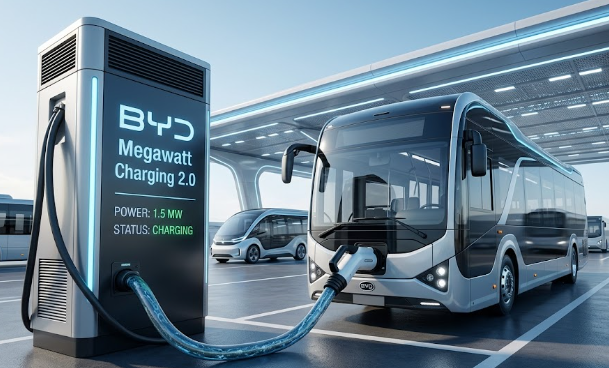
The automotive world is changing faster than most people expected. At the Auto China 2026 event, a massive shift occurred that might finally end the debate between gas and electric cars. While we previously focused on how much energy batteries can hold, the industry has now moved to a “spec war” regarding charging speeds. BYD’s Megawatt Charging 2.0 is at the center of this revolution, promising to make the charging experience quicker than a traditional trip to the gas station.
For years, “range anxiety” kept many drivers away from electric vehicles (EVs). People worried about being stuck at a charger for an hour. However, the introduction of 1,200V systems changes the game entirely. This new technology allows cars to take in massive amounts of power without damaging the battery. Consequently, the time you spend waiting for a charge is about to drop significantly.
Understanding the 1,200V Architecture Shift
To understand why this matters, we must look at how electricity moves. Most modern fast-charging EVs, such as the Porsche Taycan, use 800V systems. However, moving to a 1,200V system is a massive technical leap. Think of electricity like water flowing through a pipe. If you increase the pressure (voltage), you can move more water through the same pipe without needing a bigger hose.
Because the voltage is higher, the car can accept more power while generating less heat. This is a critical breakthrough because heat is the biggest enemy of fast charging. When batteries get too hot, the charging speed slows down to protect the hardware. By using a 1,200V platform, BYD’s Megawatt Charging 2.0 allows the car to maintain its peak charging speed for a much longer time.
The Five-Minute Range Milestone
The most shocking news from the 2026 expo involves the actual charging times. BYD claims that their new system can add 400 km (about 248 miles) of range in only five minutes. Similarly, Dongfeng unveiled a ,1200V system that promises 450 km in the same five-minute window. This is a massive improvement compared to the chargers we used just two years ago.
For the average driver, five minutes is the exact amount of time it takes to buy a cup of coffee or use the restroom. If you can gain enough energy for a week of commuting in that short time, the convenience of a gas station disappears. Therefore, the “km-per-minute” of charging has become the most important specification for any new car buyer in 2026.
The Power of Silicon Carbide (SiC)
You might wonder how these cars handle such intense power without melting. The secret lies in fourth-generation Silicon Carbide (SiC) power modules. In the past, manufacturers used standard silicon for power electronics. However, silicon is not very efficient at high temperatures. It loses a lot of energy as heat, which limits how fast a car can charge.
SiC is a “wide-bandgap” material that is far more efficient than regular silicon. These new modules reduce energy loss by up to 50%. Because less energy turns into heat, the vehicle remains cool even when BYD’s Megawatt Charging 2.0 is pumping in huge amounts of electricity. This technology ensures that the internal components stay safe while the battery fills up at lightning speed.
Upgrading the Charging Infrastructure
While the cars are ready, the charging stations must also evolve. To support these ultra-fast speeds, a station must deliver between 600kW and 1MW (one megawatt) of power. This is a massive amount of energy, roughly enough to power hundreds of homes simultaneously. Consequently, the cables at these stations have also changed.
In 2024, high-power cables were heavy and very stiff, making them hard to use. Today, we see a trend toward “Liquid-Cooled Terminals.” These chargers circulate a cooling liquid through the cable and the plug. This cooling allows the cables to stay thin and flexible while carrying huge amounts of current. As a result, even a small person can easily plug in a megawatt-class charger without struggling with a heavy hose.
When Can You Buy These Cars?
Many people assume that such advanced technology is years away. However, these 1,000V and 1,200V platforms are not just science experiments. Manufacturers have already integrated them into production-ready models. These vehicles are scheduled for delivery to customers starting in late 2026. Unlike solid-state batteries, which are still mostly in the testing phase, high-voltage charging is ready for the mass market now.
The “Death of the Charging Wait” is finally here. If you are a civil engineer or a tech enthusiast, you can see how this will reshape our cities. We may no longer need massive gas stations on every corner. Instead, small, high-power hubs will serve as the new fueling points. For more technical insights into electrical infrastructure and vehicle design, you can visit IEEE Spectrum for detailed engineering reports.
References
- BYD Auto China 2026 Technical Presentation on Megawatt Charging 2.0.
- Dongfeng Motor Group: 1,200V Platform White Paper (April 2026).
- Journal of Power Electronics: Efficiency Gains in 4th Gen Silicon Carbide Modules.
- Electric Vehicle Infrastructure Report: The Transition to Liquid-Cooled Megawatt Terminals.