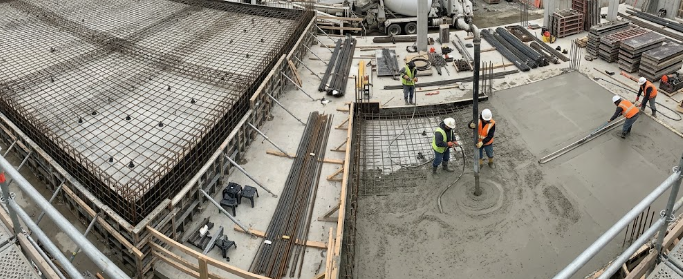
Have you ever wondered how builders create strong floors and roofs? The secret lies in constructing a reinforced concrete slab. A concrete slab is a flat, thick plate that carries heavy loads in buildings. Whether you want to build a house floor or an upper floor, you must understand this process.
In this guide, we will walk you through the simple steps of constructing a reinforced concrete slab. Consequently, you will learn how to prepare your site, fix steel bars, pour concrete, and cure it properly.
Site Preparation for Constructing a Reinforced Concrete Slab
First and foremost, you must prepare the site properly before constructing a reinforced concrete slab. If you are building a ground slab, you need to level the earth. Furthermore, you will lay a hardcore base—usually broken blocks or stones—to provide a solid foundation. Afterward, you must place a damp-proof membrane (DPM). The DPM acts like a plastic shield. It prevents moisture from traveling up from the ground into your dry concrete.
On the other hand, if you want to build a suspended slab (an upper floor), you do not need soil leveling. Instead, you will set up a strong supporting structure using timber or steel props. This temporary support will hold the heavy wet concrete until it dries completely.
Setting Up Formwork When Constructing a Reinforced Concrete Slab
Next, you must build sturdy formwork. Formwork is simply a temporary wooden or steel mold. Builders use it to shape the wet concrete during the process of constructing a reinforced concrete slab. Therefore, you must construct the formwork securely. If you make a weak mold, the heavy wet concrete will break it and spill everywhere.
Additionally, you need to apply mold oil on the inside of the formwork. This oil ensures the wood does not stick to the dry concrete later. Once you finish the mold and double-check all supports, you can move on to placing the steel reinforcement bars.
Fixing Reinforcement for Constructing a Reinforced Concrete Slab
Concrete is very strong when you press it, but it breaks easily when you bend it. Therefore, you must add steel reinforcement bars (rebar). Builders tie these steel bars together to form a grid. This grid acts like the skeleton of your slab, giving it the power to resist bending forces.
Most importantly, you must lift the steel grid slightly off the formwork bottom. Builders use small concrete blocks called spacer blocks to achieve this. The spacer blocks create a gap, ensuring the wet concrete completely surrounds the steel. We call this gap the “concrete cover.” Proper concrete cover protects the steel from rust and fire over the years.
Mixing and Pouring the Concrete
After you approve the steel work, you will start pouring the concrete. First, you must mix the concrete correctly. Many sites use volumetric batching. In this method, workers use headpans to measure cement, sand, and granite accurately. For example, a common mix ratio uses one part cement, two parts sand, and four parts granite.
Moreover, you must strictly control the water-to-cement ratio while constructing a reinforced concrete slab. If you add too much water, the concrete becomes weak. Therefore, only add enough water to make the mixture workable. Once the mix is ready, pour it quickly and spread it evenly across the entire formwork area.
Compacting the Concrete Slab
As you pour the concrete, you will trap air bubbles inside it. These air voids create weak spots in the final structure. Consequently, you must remove these bubbles to ensure maximum structural strength.
To achieve this, you will use a mechanical poker vibrator. You dip the vibrating metal tube into the wet concrete. The fast vibrations shake the mixture and force the trapped air to the surface. However, you must not vibrate the concrete for too long. If you over-vibrate, the heavy granite stones will sink to the bottom, leaving only a weak sandy paste on top.
Curing After Constructing a Reinforced Concrete Slab
Finally, you must cure the concrete. Curing simply means keeping the concrete moist so it gains full strength. Concrete does not dry by evaporation; it hardens through a chemical reaction with water. Therefore, if you let it dry too fast, it will crack and weaken.
You should cure the concrete for 7 to 14 days. You can use several simple methods to do this. For ground slabs, you can build small sand walls around the edges and flood the surface with water, which builders call ponding. Alternatively, you can cover the slab with wet hessian sacks or spray chemical curing compounds to trap the moisture. For more detailed information on advanced curing techniques, you can visit the American Concrete Institute for further reading.
References
- Chudley, R., & Greeno, R. (2014). Building Construction Handbook. Routledge.
- Mosley, W. H., Bungey, J. H., & Hulse, R. (2007). Reinforced Concrete Design. Palgrave Macmillan.