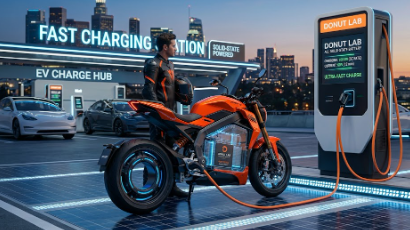
The automotive world is buzzing this week over the world-first mass-produced Donut Lab solid-state battery. Unveiled at CES 2026 and officially shipping this May, this technology marks a historic shift in how we power vehicles. Unlike the liquid-filled batteries in your current phone or car, this solid-state system is ready for large-scale use. It starts with high-performance motorcycles from Verge Motorcycles before moving into passenger cars later this year.
The 5-Minute Full Charge Milestone
The most exciting feature of the Donut Lab solid-state battery is its incredible charging speed. It can accept a full charge in roughly five minutes, which effectively matches the time you spend at a gas pump. This “killer spec” removes the biggest hurdle for electric vehicle (EV) adoption: long wait times. Drivers no longer need to plan their day around a 45-minute charging stop during long road trips.
While current EVs require careful planning, this new battery behaves like a traditional fuel tank. You pull up, plug in, and by the time you buy a coffee, your vehicle is ready to go. This rapid energy transfer is possible because solid materials handle heat much better than liquid electrolytes. Consequently, the battery does not catch fire or degrade when hit with massive amounts of electricity.
Double the Energy Density for Longer Trips
Manufacturers can now offer over 600 miles of range without making cars heavier or larger. This is because the Donut Lab solid-state battery offers roughly double the energy density of current lithium-ion packs. In simple terms, you can fit twice as much “fuel” into the same amount of space. For a civil engineer or a site manager, this means driving to remote project locations without worrying about the next charge.
Heavy battery packs have always been a downside for EVs, as they affect braking and tire wear. By doubling the energy density, Donut Lab allows car makers to reduce the physical size of the battery. This change results in lighter vehicles that are more efficient and cheaper to maintain over time.
Reliable Performance in Extreme Weather
Solid-state batteries solve the “winter range loss” problem that has frustrated many early EV owners. Standard batteries often struggle in severe cold, but the Donut Lab solid-state battery performs consistently down to -30°C. It also handles extreme heat above 100°C without losing its ability to hold a charge. This thermal stability ensures that your car starts and runs perfectly, whether you are in a desert or a snowstorm.
The Need for Megawatt Infrastructure
To achieve these 5-minute speeds, the world needs a new type of charging station. The Donut Lab solid-state battery requires a 1,500kW Megawatt Charging network to reach its full potential. Currently, companies like BYD are rolling out these high-power stations to support the new technology. Without this “Megawatt” infrastructure, the battery will still charge faster than old models, but it won’t hit the 5-minute record.
References
- Donut Lab Official. (2026). CES 2026: The Future of All-Solid-State Batteries.
- Verge Motorcycles. (2026). Shipping Schedules for Solid-State Powered Superbikes.
- BYD Global. (2026). The Expansion of the 1.5MW Megawatt Flash Charging Network.
For more technical details on battery chemistry and energy storage, you can visit IEEE Spectrum.