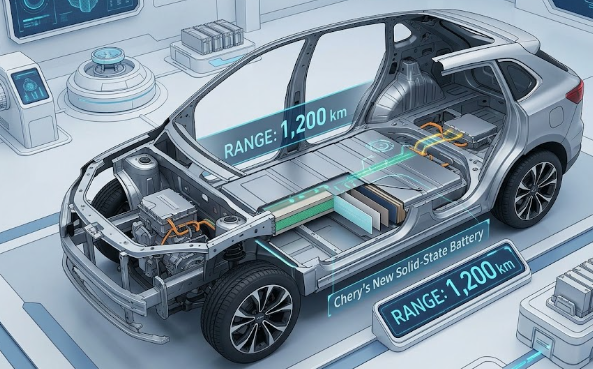
The automotive world changed forever on April 26, 2026. For many years, drivers hesitated to buy electric vehicles (EVs) because of range anxiety. They feared the battery would die before they reached their destination. However, Chery’s New Solid-State Battery just proved that those days are over. This new technology offers a massive 1,200km range on a single charge. Consequently, this distance beats almost every gas-powered vehicle currently on the road.
Understanding the Power of Chery’s New Solid-State Battery
The secret behind this performance is a number: 600 Wh/kg. In simple terms, this measures energy density, or how much power a battery can hold for its weight. Most current electric cars use lithium-ion batteries that sit between 250 and 300 Wh/kg. By reaching 600 Wh/kg, Chery has effectively doubled the industry standard. This achievement is the “holy grail” for engineers because it allows cars to go further without needing more space for batteries.
For example, imagine a standard fuel tank in a car. If you could suddenly make that same tank hold twice as much gasoline, you would double your driving distance. Chery’s New Solid-State Battery does exactly that with electricity. This breakthrough means a driver could travel from Paris to Berlin or New York to Charlotte without stopping once to plug in. Furthermore, the high density ensures that even large SUVs can achieve sports-car-level range.
Safety Breakthroughs in Solid-State Technology
Safety remains a top priority for every car owner. Traditional batteries use a liquid electrolyte to move energy. Unfortunately, this liquid is flammable and can leak if the car crashes. In contrast, Chery’s New Solid-State Battery uses a solid material to move energy. This change makes the battery incredibly stable. During recent public demonstrations, engineers performed “nail penetration” tests where they drove a metal spike through the battery cell.
The results were impressive. While a standard battery might smoke or catch fire, this solid-state cell remained cool and safe. It also handles extreme heat much better than liquid versions. Because it does not catch fire when punctured or crushed, it provides a new level of security for families. Additionally, the solid structure prevents the growth of “dendrites,” which are tiny spikes that can cause short circuits in older batteries.
How Chery’s New Solid-State Battery Changes Charging
Charging speed is another major hurdle for EV adoption. Most people do not want to wait 45 minutes at a rest stop. However, the architecture of Chery’s New Solid-State Battery allows it to take in a huge amount of electricity very quickly. During the live demo, Chery showed that the battery could gain 150km of range in just one minute. This speed makes a charging stop almost as fast as filling up a tank at a traditional gas station.
| Feature | Current Lithium-Ion | Chery Solid-State |
| Energy Density | 250-300 Wh/kg | 600 Wh/kg |
| Max Range | 500-600 km | 1,200+ km |
| Charging Speed | 100km in 5-10 mins | 150km in 1 min |
| Safety | Flammable Liquid | Non-flammable Solid |
As a result, long road trips will feel much more convenient. You can stop for a quick coffee, and by the time you return to the car, you have enough power for another two hours of driving. This efficiency removes the final advantage that internal combustion engine (ICE) vehicles held over electric ones.
Reducing Weight for Better Performance
Weight is a silent enemy in car design. Heavy batteries make cars harder to stop and slower to turn. They also cause tires and brakes to wear out much faster. Because Chery’s New Solid-State Battery is so dense, automakers can choose two paths. They can either provide a massive 1,200km range or use a smaller battery to cut the car’s weight in half while keeping a standard range.
For the readers of specsfinder.info, this means future EVs will be much more agile. Lighter cars are more fun to drive and more efficient on the road. Moreover, reducing weight helps the environment because the car requires less energy to move. This weight advantage will likely lead to cheaper tires and lower maintenance costs over the life of the vehicle.
The Timeline to Mass Production
While this technology looks like science fiction, it is arriving sooner than you think. Chery plans to bring these all-solid-state cars to the mass market by 2027. Other companies like NIO are already shipping cars with “semi-solid” packs, but Chery’s 600 Wh/kg prototype is the real leap forward. The race is now on to see which manufacturer can scale up production first.
In conclusion, we are witnessing the hardware finally catching up to our needs. The “ICE Age” of gasoline engines is ending because the electric alternative is now better in every way. For more technical details on the future of automotive energy, you can read further on Electrek.
References
- Chery Global Automotive Technology Report (April 2026).
- Solid-State Battery Energy Density Standards, International Energy Agency.
- Advanced Materials Journal: Comparative Study on Solid vs. Liquid Electrolytes.
- NIO 150kWh Semi-Solid Pack Production Roadmap.