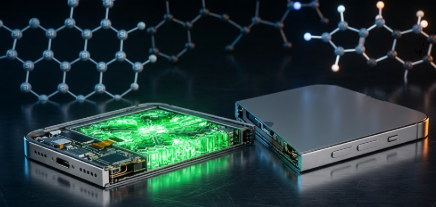
Smartphone users have suffered from battery anxiety for over a decade. We constantly look for wall outlets or carry heavy power banks just to survive a full day of work. However, a massive hardware shift is currently dominating Android tech circles. Chinese smartphone manufacturers have officially scaled silicon-carbon battery technology to change the mobile industry completely.
According to mid-May reports from TechRepublic, this new engineering breakthrough officially replaces traditional Lithium-ion cells. Consequently, manufacturers are pushing entry-level flagship capacities to an astonishing 8,000mAh. Best of all, they achieve this massive capacity upgrade without increasing the thickness of the handset.
The Science Behind Silicon-Carbon Battery Technology
To understand this upgrade, we must look at how standard batteries work. Traditional smartphone batteries use graphite for their negative sides, which scientists call anodes. However, graphite has strict physical limits on how many lithium ions it can hold. Consequently, a graphite battery must physically grow larger and thicker if you want it to store more energy.
Fortunately, shifting to silicon-carbon anodes changes the entire game. Silicon can naturally hold up to 300% more lithium ions by volume than graphite. Think of it like replacing a regular kitchen sponge with a super-absorbent microfiber cloth that holds three times more water in the exact same size. Therefore, this chemistry allows manufacturers to cram massive capacity into an ultra-slim chassis that measures under 8.5mm thick.
Real-World Power: The Multi-Day Spec
What does an 8,000mAh battery mean for your daily routine? To translate these numbers into real life, you can expect three to four days of moderate use on a single charge. You will no longer need to plug in your phone every single night or worry about your screen dying during a busy day.
Furthermore, this technology perfectly supports modern, power-hungry mobile features. For instance, heavy users can enjoy over 24 hours of continuous on-device AI local processing. Because local artificial intelligence tasks consume massive amounts of energy, old graphite batteries would drain within hours. This new capacity handles heavy AI tasks easily, so you can enjoy advanced features without any stress.
Wired Charging Profiles and Heat Management
You might worry that a massive 8,000mAh tank takes hours to charge. However, the new chemistry solves this problem through superior heat dispersion. Because the silicon-carbon mixture handles heat much better than old battery materials, the cell safely supports high-power charging without overheating.
Specifically, these cells stably handle 60W to 100W fast charging profiles. As a result, you can fill the massive battery from 0% to 100% in roughly 35 minutes. This speed means you get multiple days of usage out of a quick morning charge while you get ready for work.
Long-Term Lifespan of Silicon-Carbon Battery Technology
In the past, pure-silicon battery prototypes failed because they suffered from severe structural swelling. The material expanded so much during charging that it physically ruined the internal components of the phone. Thankfully, combining silicon with carbon fixes this exact problem.
This advanced mixture offers incredible degradation resistance. The carbon structure acts as a protective cage that keeps the silicon stable. Therefore, these anodes suffer far less swelling over time. Amazingly, the battery retains 80% of its original health even after 1,600 charging cycles. For the average user, this translates to approximately four years of daily fast charging before you notice any major drop in performance.
Conclusion
The era of dead phone batteries is finally coming to an end. By packing massive capacities into ultra-thin devices, silicon-carbon battery technology completely redefines our expectations for mobile hardware. You can now experience multi-day battery life, blazing-fast charging speeds, and exceptional long-term durability without carrying a thick, bulky brick in your pocket. To explore more about how modern hardware innovations are transforming the mobile industry, you can read the latest smartphone tech coverage on TechRepublic.
References
TechRepublic. (2026). Mid-May Mobile Hardware Reports: The Scale of Silicon-Carbon Energy Cells in Android Flagships.