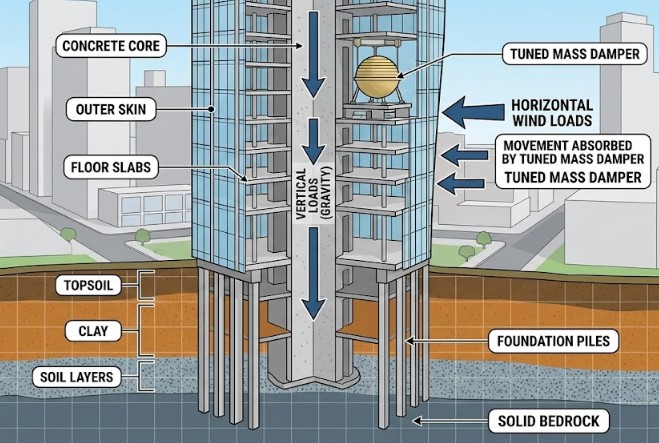
You probably wonder how skyscrapers stay standing despite their incredible height and weight. These giants of the modern city are masterpieces of engineering. Architects and civil engineers use advanced principles of physics and materials science to create buildings that defy gravity and resist powerful forces. It is not just the steel and concrete you see, but the complex, invisible structural systems that keep these massive towers stable and secure. Understanding how skyscrapers stay standing reveals the incredible ingenuity behind our urban skylines. We will now explore the specific techniques and designs that make these structures possible.
Resisting Gravity with Core Strength
The most obvious challenge for a skyscraper is its own weight. To keep the building from collapsing under its immense mass, engineers use a very strong central support. This is called the “core.” Imagine the core as the spine of the building. It is a robust vertical column, usually made of reinforced concrete or steel, that runs from the foundation all the way to the very top. This core is designed to carry most of the building’s weight directly down to the ground. In many designs, smaller, thinner columns support the outer edges of the building and transfer their load to the core. This clever system is fundamental to how skyscrapers stay standing safely against the pull of gravity.
Fighting the Wind
The higher you go, the stronger and more unpredictable the wind becomes. Therefore, skyscrapers must be designed to withstand immense wind pressures. The wind doesn’t just push against the side of a building; it also creates swirling currents that can make the building sway uncomfortably. To combat this, engineers shape skyscrapers to deflect the wind, rather than just blocking it. Many towers have rounded or tapered shapes that allow the wind to flow around them. Some tall buildings even feature a tuned mass damper. This is a massive weight, like a giant steel pendulum, suspended near the top. When the wind makes the building sway one way, the damper moves the other, counteracting the movement and ensuring stability. This system plays a key role in how skyscrapers stay standing and remain comfortable for their occupants.
A Foundation for Success
Even the strongest skyscraper is only as good as its foundation. A building’s foundation must support its entire weight and keep it from sinking or tipping. For skyscrapers, the foundation has to be deep and wide. In many cities, engineers must dig far down, sometimes hundreds of feet, to find solid rock. They then construct massive concrete piers that anchor the building’s core directly to that bedrock. If solid rock is too deep, they may use long piles, which are like long, thick nails, that are driven deep into the soil to create friction and support. A strong, stable foundation is crucial for how skyscrapers stay standing for many decades.
A Simple Breakdown of the Science
| Feature | Function | Analogy |
| Central Core | Carries vertical load (gravity) to the ground. | A person’s spine. |
| Aerodynamic Shape | Deflects wind, reduces swaying. | An airplane wing. |
| Deep Foundation | Anchors the building, prevents sinking. | The roots of a giant tree. |
Designing for Longevity and Safety
Every skyscraper you see is a remarkable combination of innovative design and rigorous engineering. The people who build these wonders consider everything from the strength of the steel to the way a skyscraper will react to an earthquake or extreme weather. When you look at a tall building now, you should appreciate the unseen science and careful planning that make it possible. By mastering the core principles we’ve discussed, engineers answer the complex question of how skyscrapers stay standing so that we can enjoy our modern cities with confidence. You can learn more about skyscraper engineering here.
References
- National Academy of Engineering (2024). Advances in High-Rise Construction.
Smith, R. (2023). Understanding Structural Loads and Forces.