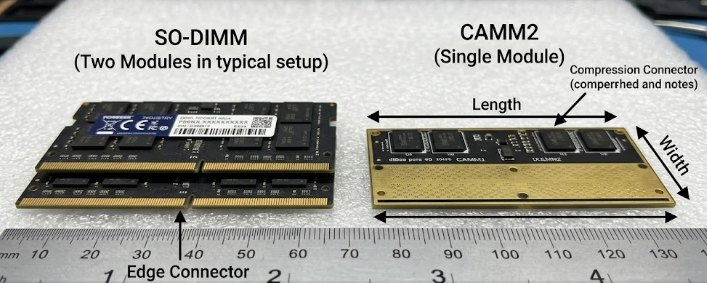
Technology changes fast, and laptop memory is no exception. Today, we are looking at a major upgrade in how laptops handle memory: CAMM2 vs. SO-DIMM. For over twenty years, laptops have used Small Outline Dual In-Line Memory Modules (SO-DIMM). However, as laptops get thinner and processors get faster, the old design struggles to keep up. Therefore, the tech industry created the Compression Attached Memory Module (CAMM2) standard. This new design solves many problems that hold back modern computers. In this article, we will compare CAMM2 vs. SO-DIMM so you understand what makes the new standard much better for your next laptop.
Understanding the Shift: CAMM2 vs. SO-DIMM
First, we need to understand why laptop makers want a new memory standard. Laptops need to be slim, but they also need massive computing power. Consequently, manufacturers often solder the memory directly to the motherboard to save space and boost speed. Unfortunately, this means you cannot upgrade the memory later. If you buy a laptop with 16GB of RAM, you are stuck with it forever. The debate of CAMM2 vs. SO-DIMM changes this entirely. CAMM2 gives you the amazing speeds of soldered memory while allowing you to easily replace or upgrade the module whenever you want.
The Physical Footprint Advantage
Let us look at the physical size difference. Space inside a modern laptop is extremely valuable. Traditional SO-DIMM slots take up too much room because they stack modules on top of each other. Furthermore, the plastic connector itself is bulky. The JEDEC CAMM2 specification solves this space issue brilliantly. Specifically, a CAMM2 module connects flat against the motherboard using compression. As a result, this design reduces the physical space required on a laptop motherboard by up to 57% compared to traditional stacked SO-DIMM slots. Therefore, manufacturers can use that saved space to give you larger batteries or better cooling fans.
Speed and Architecture: Unlocking LPDDR5X
Speed is another crucial factor when comparing CAMM2 vs. SO-DIMM. Modern laptops need ultra-fast memory to handle demanding tasks smoothly. Previously, if you wanted the fastest Low-Power Double Data Rate (LPDDR5X) memory, the manufacturer had to solder it directly to the laptop motherboard. SO-DIMM simply cannot handle the high signal speeds required for LPDDR5X. However, CAMM2 changes the game completely. This new architecture allows for ultra-fast LPDDR5X memory to be fully user-replaceable and upgradeable. Now, you can buy a fast laptop today and easily swap in more high-speed memory tomorrow.
Dual-Channel Efficiency with CAMM2 vs. SO-DIMM
Another incredible benefit of CAMM2 is how it handles memory channels. In the past, achieving top performance meant you had to buy two identical RAM sticks. This setup, known as dual-channel memory, allowed the processor to talk to both sticks at the same time. If you only bought one SO-DIMM stick, your laptop ran much slower. Conversely, CAMM2 achieves dual-channel memory speeds from a single module. This innovation completely eliminates the strict requirement to buy RAM in pairs for peak performance. Thus, upgrading becomes much cheaper and easier for everyone.
What This Means for Laptop Buyers
Ultimately, the battle of CAMM2 vs. SO-DIMM brings huge benefits to consumers and IT professionals. If you manage a fleet of workstations, you can now easily upgrade thin-and-light laptops without buying completely new machines. Additionally, everyday buyers do not have to worry about paying high prices for extra memory at the time of purchase. You can confidently buy a base model and upgrade the CAMM2 module yourself later. Clearly, CAMM2 represents the future of flexible, high-performance mobile computing.
Conclusion
In conclusion, the tech industry is clearly moving away from the old standard. The comparison of CAMM2 vs. SO-DIMM proves that CAMM2 is superior in speed, size, and upgradeability. It saves valuable motherboard space, unlocks blazing-fast LPDDR5X speeds, and simplifies upgrades by offering dual-channel performance on just one module. Soon, almost all premium laptops will feature this incredible technology. For further reading on computer memory standards and detailed hardware specifications, you can visit JEDEC’s official website.
References
- JEDEC Solid State Technology Association. (2023). “JEDEC Publishes CAMM2 Memory Module Standard.”
- Dell Technologies. (2022). “Introducing CAMM Architecture.”